Table of Contents
The Thirst of Concrete: How Sika Superplasticizers are Reducing Water Consumption in Pakistan
Introduction: A Story of Two Buckets
Imagine two construction sites. At the first, a laborer named Yusuf mixes concrete the old way. He adds bucket after bucket of water to make the mix flow easily. The concrete looks workable, but he knows—from years of experience—that this ease comes at a cost. The foundation he is pouring today might crack sooner than it should.
At the second site, something different is happening. The mixer turns, but only a fraction of the water is being added. Instead, a small dose of an amber-colored liquid—a Sika superplasticizer—is poured in. The concrete transforms. It flows like a river, yet it holds together with a strength that Yusuf instinctively knows will last for generations.
This is not just a story about chemistry. It is a story about reducing water consumption in a country where water scarcity is becoming one of our greatest challenges. And it is a story about how Sika Chemicals Pakistan is helping builders like Yusuf pour a better future.
The Invisible Crisis: Water in Concrete
When we think about water usage in Pakistan, we think of agriculture, drinking water, and household use. We rarely think about concrete. Yet, after water itself, concrete is the most consumed substance on Earth, and it is incredibly thirsty.
For decades, the construction industry has relied on a simple equation: more water equals easier workability. But this shortcut has a hidden cost.
Every liter of mixing water beyond what is chemically required to hydrate cement creates capillary pores. Think of it like tiny tunnels running through your concrete. Through these pores, water seeps in, carrying chlorides and sulfates that rust the steel reinforcement. The structure weakens from the inside out .
This is where the science of reducing water consumption transforms from an environmental talking point into a structural imperative.
The Magic of Polycarboxylate Technology
Enter Sika’s ViscoCrete® technology. Unlike old-school plasticizers (like lignosulfonates or naphthalene-based products), which only offered a 5-12% water reduction, Sika’s third-generation polycarboxylate polymers achieve something remarkable .
Here is how it works, explained simply:
Cement particles are naturally attracted to each other. They clump together, trapping water between them. A superplasticizer acts like a sophisticated dispersant. It adsorbs onto the surface of each cement particle and, through a combination of electrostatic repulsion (like magnets pushing against each other) and steric hindrance (a physical, bulky side-chain barrier), it pries the particles apart .
This dispersion unlocks the water trapped in the clumps. Suddenly, you have a highly fluid concrete mix without adding a single extra drop of water.
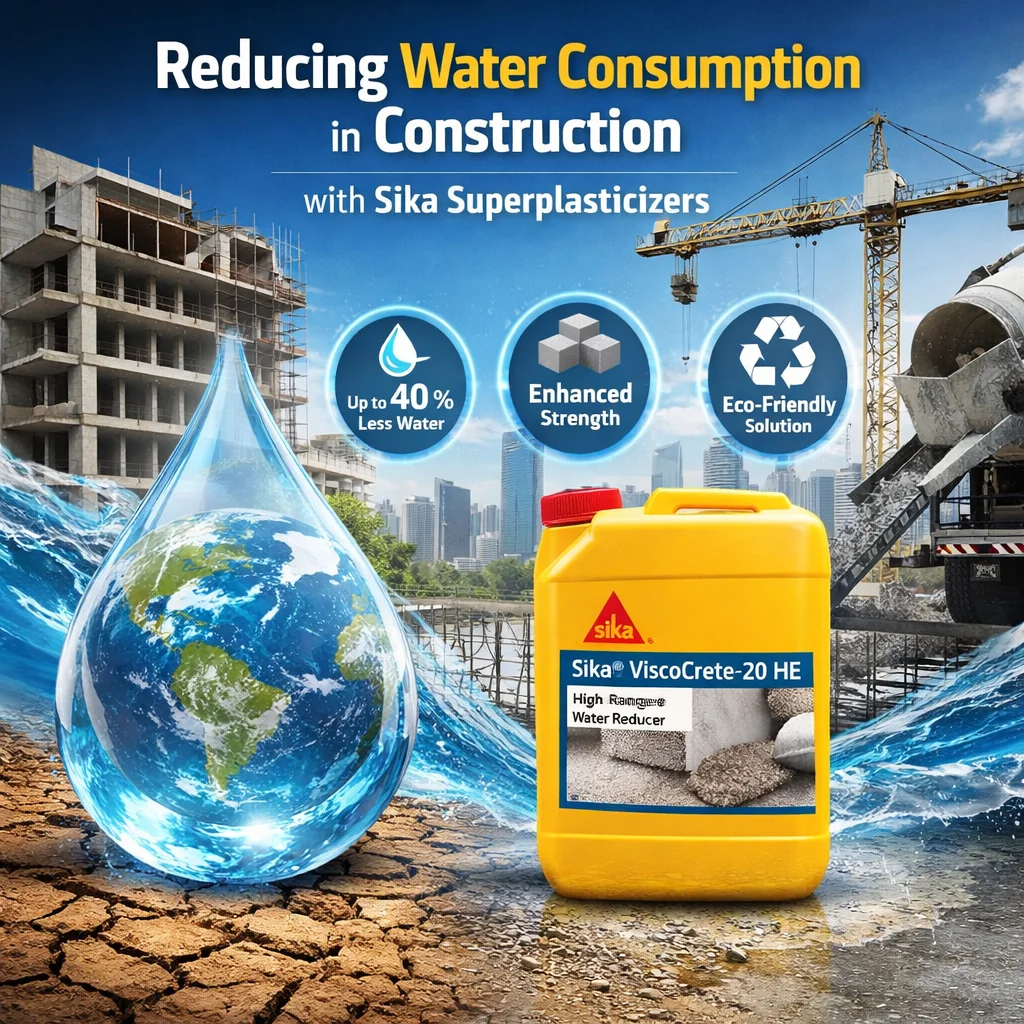
The result? Water reduction of up to 30-40% compared to traditional mixes .
Beyond Water: The Chain Reaction of Savings
When you commit to reducing water consumption with Sika admixtures, you trigger a cascade of positive effects that impact the entire project lifecycle.
1. Stronger, Denser Structures
The American Concrete Institute recently published research showing that mixtures with high-range water reducers (HRWR) and reduced water content saw over a 30% increase in mechanical strength and a 40% lower water absorption rate . A lower water-to-cement ratio means fewer capillaries. Fewer capillaries mean a fortress-like barrier against the elements.
For Pakistani clients building in humid cities like Karachi or the salt-heavy soils near the coast, this durability is not just a bonus—it is a necessity.
2. The Cement Reduction Opportunity
Here is a perspective shift that many contractors miss: If you are reducing water consumption, you can also consider reducing cement while maintaining the same strength.
Because superplasticizers make the cement work harder, you can achieve your target strength with less binder. This directly tackles the massive carbon footprint of cement production . One study demonstrated that optimized mixes could reduce life-cycle costs by 29% while extending the service life of concrete by up to 117% . That is the kind of math that wins bids.
3. The Bio-Based Revolution
Sika is not stopping at performance. They are the first company to launch a bio-based superplasticizer on the market. Sika ViscoCrete®-850 Végétal replaces over 85% of petroleum-based raw materials with renewable vegetable substances derived from agricultural by-products .
For the environmentally conscious builder, this represents a paradigm shift. You are no longer choosing between “green” and “strong.” You are getting both.
On the Ground: Pakistan-Specific Realities
Talking to suppliers like MCT Chemicals, an authorized wholesaler for Sika Pakistan, reveals the ground-level impact. Pakistan’s extreme temperatures—from the scorching heat of southern Punjab to the chilly winters up north—pose unique challenges to concrete placement .
Heat is the enemy of fresh concrete. It accelerates the hydration reaction, meaning the concrete stiffens faster (loses slump), leaving workers less time to place and finish it. The natural reaction for many site supervisors is to add more water on-site to “loosen it up.” This is disastrous.
However, with Sika ViscoCrete technology, the mix retains its workability longer without added water. The polymer chains maintain dispersion, giving your team the time they need to do the job right .
Furthermore, in a country facing water scarcity, every gallon saved matters. Municipal water supply is erratic in many industrial areas. Bore well water quality varies. By drastically reducing water consumption in every cubic meter of concrete, we ease the burden on local water tables.
The Practical Guide: Implementing Water Reduction on Your Site
If you are convinced and ready to start reducing water consumption, here is how to implement Sika superplasticizers effectively.
Step 1: Choose the Right Product
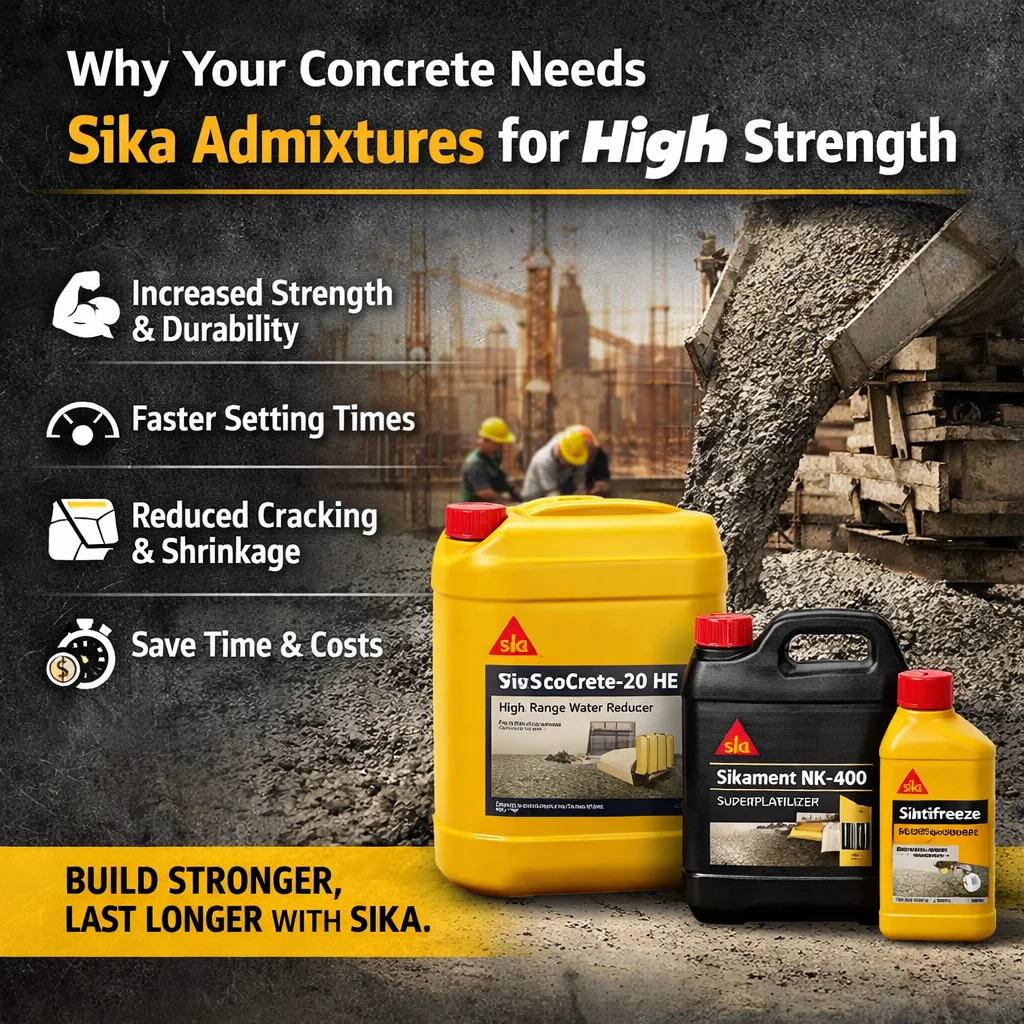
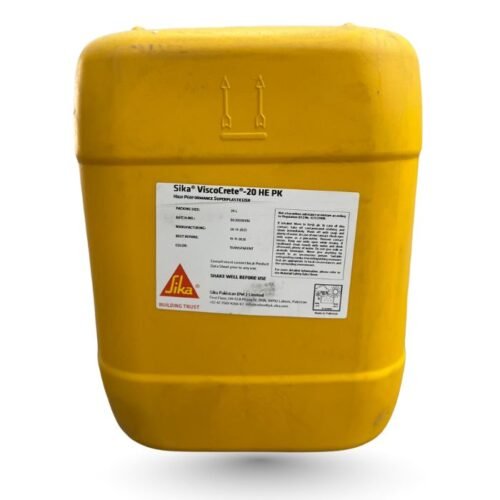
- Sika ViscoCrete®-20 HE: A high-range water reducer perfect for ready-mix concrete requiring high early strength [citation:website].
- Sika ViscoFlow®-3400 LV: Excellent for pumped concrete and high-rise buildings, offering superior workability retention .
- Sika ViscoCrete® G-2: Specifically designed for gypsum-based products, but its technology highlights the versatility of the polymer platform .
Step 2: Mix Design Optimization
Do not just “splash and dash.” Work with Sika Pakistan’s technical team. They have a comprehensive calculation program (Sika MixDesign Calculation) that shows the ecological and economic benefits immediately for every recipe comparison . They will help you find the sweet spot between water reduction, workability, and strength.
Step 3: Quality Control on Site
Ensure your batching plant measures water accurately. The beauty of superplasticizers is that they are typically added after the initial mixing water, allowing for real-time slump adjustment. This prevents the common site practice of “water topping,” which ruins durability.
Conclusion: A Call to Pour Responsibly
Yusuf, the laborer from our opening story, represents the hundreds of thousands of construction workers across Pakistan. He knows good concrete when he feels it. He knows that concrete which shines smoothly without segregating is concrete that will protect his children.
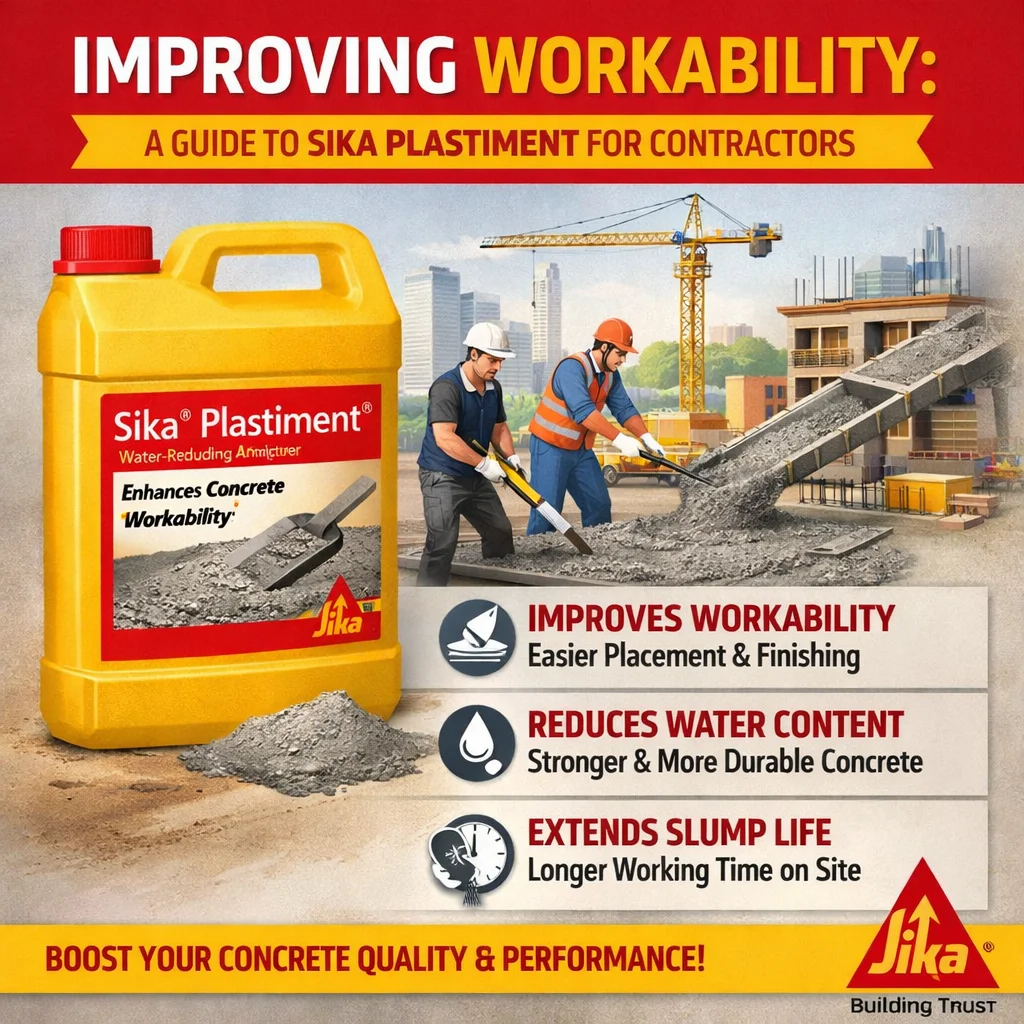
Sika superplasticizers are not just about making concrete easier to handle. They represent a fundamental shift toward responsible construction. By committing to reducing water consumption, we are choosing to build structures that last longer, cost less to maintain, and tread more lightly on our planet.
The water we save today is the water our cities will drink tomorrow.
Ready to Transform Your Mix?
Are you ready to pour concrete that is stronger, more durable, and more sustainable?
Visit Sika Chemicals Pakistan today to explore our full range of ViscoCrete® superplasticizers. Our team of experts is ready to help you optimize your mix design, whether you are building a home in Islamabad or a high-rise in Karachi.