Table of Contents
The Science of Strong: High-Strength Bonding for Heavy Granite and Porcelain Tiles
There is a moment in every tiling project—whether you are a seasoned professional or a determined DIYer—when you place that last heavy slab of porcelain onto the adhesive, and you hold your breath. Will it sink? Will it slip? Will it hold?
I remember my first encounter with large-format porcelain tiles. The slabs were massive—120x120cm of dense, heavy ceramic that cost a small fortune. The client had chosen them specifically for their seamless, modern look. But as I lifted the first tile into place, a nagging question crept in: Is the adhesive behind it strong enough to keep this beauty on the wall for the next twenty years?
That experience taught me something invaluable: when it comes to heavy granite and porcelain tiles, not all adhesives are created equal. What you need is high-strength bonding for heavy granite and porcelain tiles—and understanding what that truly means can make the difference between a masterpiece and a catastrophe.
Why Heavy Tiles Demand a Different Approach
Let us start with a simple truth: granite and large-format porcelain tiles are heavy. Not just “a bit heavier than ceramic” heavy—we are talking about densities that can exceed 2,400 kg/m³. A single 60x60cm granite tile can weigh upwards of 20-25 kg. Now multiply that by an entire floor or wall installation.
Traditional cement-based adhesives were designed for smaller, more absorbent ceramic tiles. They work through a mechanical bond—the adhesive seeps into the pores of both the substrate and the tile, creating a physical lock when it hardens . But here is the catch: porcelain and granite have very low porosity. They are dense, vitreous materials that simply do not allow adhesives to penetrate easily .
This is where the concept of high-strength bonding for heavy granite and porcelain tiles becomes critical. You need adhesives that create a chemical bond, not just a mechanical one—products formulated with advanced polymers and modifiers that can adhere to slick, non-absorbent surfaces.
The Science Behind the Bond
To truly appreciate what makes these high-strength adhesives work, we need to look under the hood—or rather, under the tile.
Understanding Adhesion Strength
When manufacturers talk about adhesion strength, they measure it in Newtons per square millimeter (N/mm²). A standard tile adhesive might offer around 0.5 N/mm² of initial adhesion . But high-performance products? They operate on an entirely different level.
For comparison, some advanced epoxy-based adhesives achieve bond strengths exceeding 1.5 N/mm²—more than triple the holding power . To put that in perspective, that is strong enough that the tile itself might break before the bond fails.
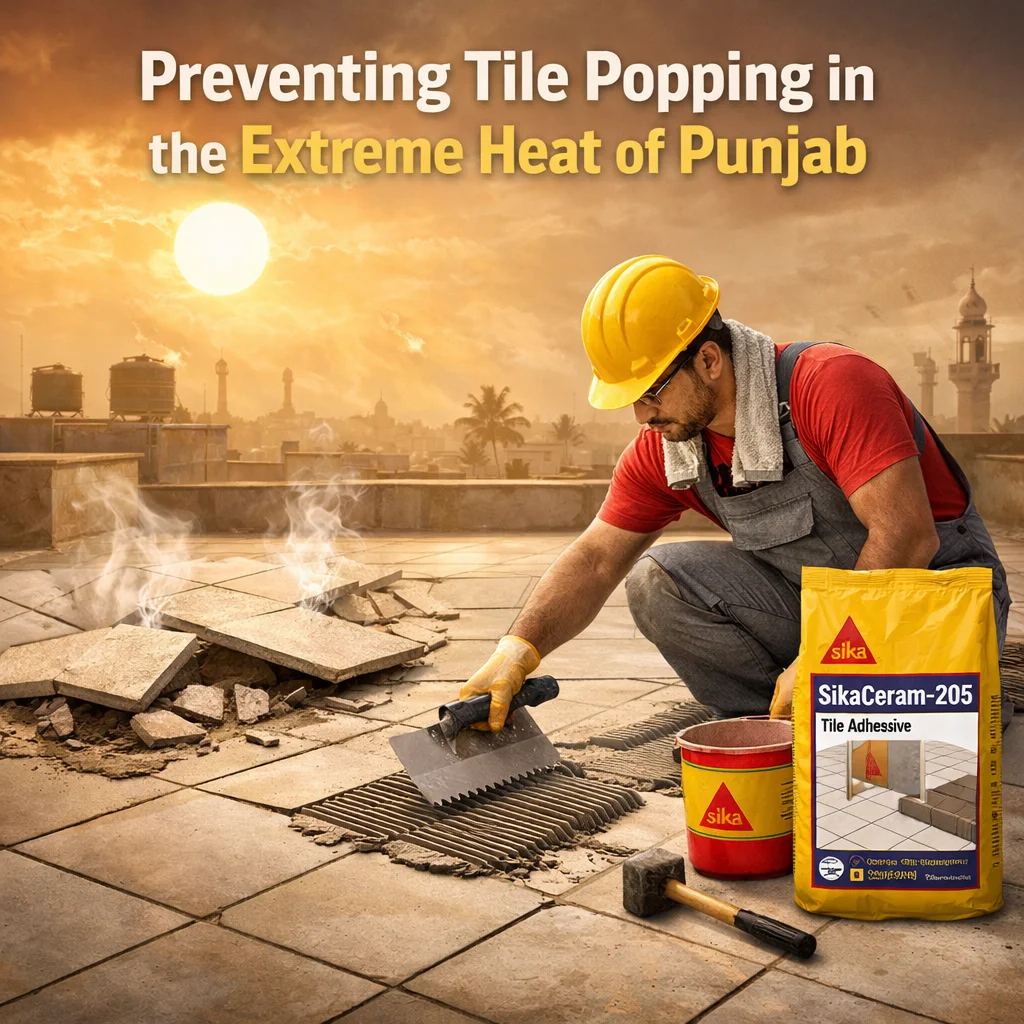
SikaCeram®-205 PK, for instance, delivers an initial tensile adhesion strength greater than 1.0 N/mm² and maintains that strength even after water immersion and thermal ageing . This kind of performance is what you need when you are trusting an adhesive to hold heavy stone slabs in place for decades.
Deformation and Flexibility
Here is something many people overlook: buildings move. They settle. They expand and contract with temperature changes. If your adhesive is rigid, something has to give—and it is usually the tile that cracks.
High-strength adhesives designed for heavy tiles incorporate flexibility modifiers. They are classified as “deformable” adhesives (often designated as “S1” or “S2” in European classifications). SikaCeram-205 PK, for example, carries a C2TE classification—the “T” indicating it is designed for large tiles, and the “E” meaning it has extended open time .
This flexibility allows the adhesive to absorb minor substrate movements without transferring stress to the tiles. Think of it as a shock absorber for your tiled surface.
Choosing the Right Adhesive: A Practical Comparison
Not all high-strength adhesives are the same. To help you navigate the options, here is a comparison of different adhesive types suitable for heavy granite and porcelain installations:
For most residential and commercial applications involving heavy granite or large porcelain tiles, a flexible cement-based adhesive classified as C2TE or C2TES1 is your best bet . It offers the strength you need with enough flexibility to accommodate movement.
The Application Techniques That Make or Break the Bond
Here is a truth I have learned through years of hands-on work: even the world’s best adhesive will fail if applied incorrectly. Achieving genuine high-strength bonding for heavy granite and porcelain tiles requires proper technique.
1. The Double-Buttering Method
Forget simply spreading adhesive on the floor and dropping the tile in place. For heavy, large-format tiles, professionals use the “double-buttering” technique .
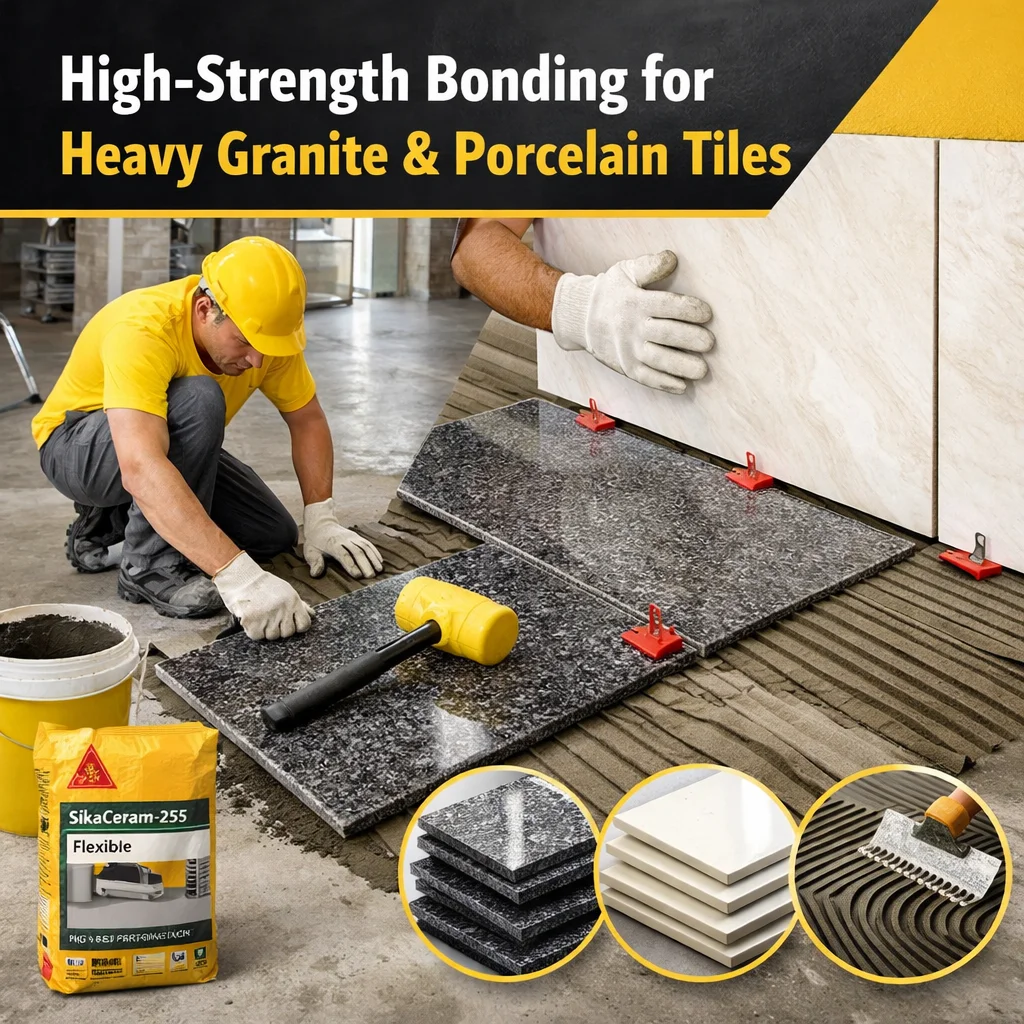
This means applying a layer of adhesive to the substrate with a notched trowel—and applying a thin, even layer (the “butter coat”) to the back of the tile itself. Why? Because it ensures 100% coverage. No voids. No weak spots. Just complete, uniform contact between tile and adhesive.
Sika’s technical data sheets explicitly recommend this method for tiles larger than 900 cm² (roughly 30×30 cm) . For the massive slabs popular in contemporary design, it is not optional—it is essential.
2. Working Within Open Time
Here is a mistake I see constantly: spreading too much adhesive at once. In warm weather, especially here in Pakistan, cement-based adhesives can begin to form a skin on the surface within 15-20 minutes . If you place a tile onto adhesive that has skinned over, you are effectively bonding the tile to a dry film—not to the wet adhesive beneath.
The result? A bond that looks good initially but fails under stress.
Professional installers spread only what they can tile within the adhesive’s “open time”—typically 20-30 minutes depending on conditions . They check adhesion by occasionally lifting a freshly placed tile to ensure the adhesive is transferring properly.
3. Back-Buttering for Irregular Tiles
Many porcelain tiles, particularly larger formats, have deep grooves or ribs on the back. These are designed to improve mechanical keying, but they can also trap air if not handled correctly .
The solution is to back-butter—use the flat side of your trowel to force adhesive into these recesses, filling them completely. Only then do you comb additional adhesive onto the substrate. This ensures the adhesive contacts every square millimeter of the tile’s surface.
Real-World Performance: What the Numbers Tell Us
Let us look at some actual performance data from independently tested products.
SikaCeram®-205 PK, a high-performance flexible adhesive available in Pakistan, maintains adhesion strength above 1.0 N/mm² even after:
- Water immersion (simulating flooded floors or wet areas)
- Heat ageing (simulating years of thermal cycles)
- Freeze-thaw cycling (critical for exterior applications)
Compare this to standard adhesives, which often lose significant strength under these conditions . For a high-traffic commercial floor or an exterior terrace subject to Pakistan’s temperature extremes, this durability difference translates directly to longevity.
For specialized applications, epoxy-based systems take strength even further. Some products achieve bond strengths over 1.8 N/mm² with the added benefit of chemical resistance . These are ideal for industrial kitchens, laboratories, or areas exposed to oils and chemicals.
Common Pitfalls to Avoid
Through years of consulting on tiling failures, I have seen the same mistakes repeated. Here is what to watch out for:
Assuming “cement-based” means “one-size-fits-all”
Standard grey cement is not an adhesive. It lacks the polymer modifiers needed to bond dense tiles. Always use formulated tile adhesives.
Skipping the primer on difficult substrates
Smooth or non-absorbent substrates like existing tiles or anhydrite screeds require proper priming. Products like Sika® Primer-10 or Primer-11W create a receptive surface for the adhesive .
Tiling in extreme conditions
Adhesives have temperature limits—typically 5°C to 35°C . Tiling in direct summer sun or during winter cold compromises curing and final strength.
Grouting too soon
The adhesive needs time to develop its full bond. Grouting the next day might seem efficient, but it can disturb the setting process. Wait at least 24 hours, sometimes longer in cool conditions .
The Verdict: Investing in Lasting Results
Here is what I want you to take away from this article: high-strength bonding for heavy granite and porcelain tiles is not a marketing gimmick—it is an engineering necessity. The weight, density, and low porosity of these materials demand adhesives specifically formulated for the task.
When you invest in premium materials like granite or large-format porcelain, you are making a long-term commitment to your space. The adhesive you choose should match that commitment. Products like SikaCeram®-205 PK—with their C2TE classification, proven adhesion strength, and flexibility—represent the peace of mind that comes from doing the job right .
In my own projects, I have learned that the few extra rupees spent on high-performance adhesive are nothing compared to the cost of replacing tiles that fail. The adhesive is literally the foundation of your tiled surface. Make it strong.
Ready to Ensure Your Tiles Stay Put for Good?
At Sika Chemicals Pakistan, we understand the demands of modern construction. Whether you are tiling a commercial lobby with heavy granite slabs or updating your home with sleek porcelain tiles, we have the certified products and technical expertise to support your project.
Visit our Products page to explore our full range of high-strength tile adhesives, including the CE-classified SikaCeram®-205 PK. Need help selecting the right product for your specific application? Our support team is just a call away at 03329015232.
Shop Collection today and build with confidence that lasts.