Table of Contents
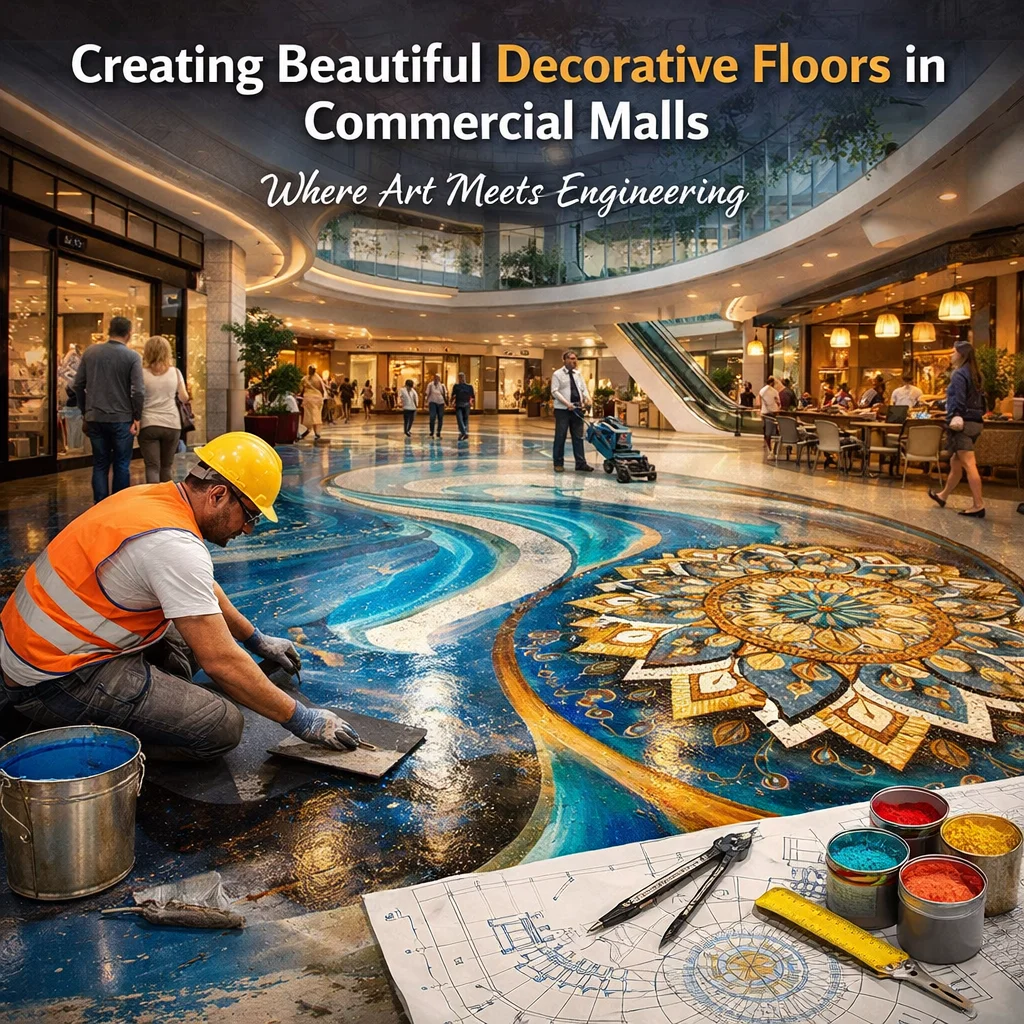
Creating Beautiful Decorative Floors in Commercial Malls: Where Art Meets Engineering
Introduction: The Floor Beneath Our Feet Tells a Story
Think about the last time you walked into a high-end shopping mall. What caught your eye first? The gleaming storefronts? The soaring atrium? Or perhaps—without you even realizing it—the ground beneath your feet.
Flooring in commercial malls is the silent storyteller. It guides your journey, absorbs the chaos of thousands of footsteps, and sets the emotional tone for everything from luxury boutiques to bustling food courts. Yet creating beautiful decorative floors in commercial malls isn’t simply about picking a pretty color. It’s a complex dance between artistic vision and brutal practicality.
I’ve walked through enough mall renovations and spoken with enough flooring contractors to know that the most stunning floors are the ones you never think about—until someone gets it wrong. A cracked terrazzo tile, a slippery surface after a spill, or a dull, worn-out corridor can silently undermine the entire shopping experience.
So how do designers and contractors pull off this balancing act? Let’s dive into the real-world strategies, materials, and lessons from projects that got it right.
Why Commercial Mall Flooring Is Different from Any Other Surface
Before we explore specific systems, it’s worth understanding what makes mall flooring uniquely demanding.
The numbers tell the story. A busy shopping mall can see anywhere from 10,000 to 200,000 visitors daily. That’s millions of footsteps per year, often accompanied by rolling suitcases, strollers, shopping carts, and the occasional spilled latte. Add in the weight of maintenance equipment, periodic renovations, and the inevitable shifting of the building itself, and you have a surface that must survive conditions closer to an airport runway than a residential living room.
But here’s the catch: unlike an industrial warehouse, a mall demands beauty. The floor must complement brand identities, create visual flow, and sometimes even serve as a landmark feature. It needs to be easy to clean (because mall cleaning crews work overnight, not during peak hours). And increasingly, it needs to meet sustainability standards for indoor air quality .
This is why creating beautiful decorative floors in commercial malls requires specialized systems designed for this exact intersection of form and function.
The Heavy-Duty Contenders: Three Systems That Deliver
Based on real-world applications and industry data, three flooring systems dominate successful mall installations. Each has distinct strengths, and the choice often comes down to traffic levels, design complexity, and project timeline.
1. Epoxy Terrazzo: The Timeless Classic
If you want a floor that will look stunning for decades, epoxy terrazzo remains the gold standard. This system combines natural marble aggregates with an epoxy resin binder, creating a seamless surface that can be ground and polished to a high gloss .
Why it works for malls:
- Exceptional durability: Epoxy terrazzo systems typically achieve compressive strengths around 73 N/mm² and flexural strengths of 20 N/mm² . In plain language: it’s incredibly tough.
- Design flexibility: With 18 standard colors and the ability to combine multiple aggregates, designers can create custom patterns, logos, or even intricate artwork .
- Slip resistance: Properly finished terrazzo can achieve R11 slip resistance ratings, meeting safety standards for public spaces .
Real-world example: The Greenstone Shopping Centre in Johannesburg recently transformed its food court using a fast-track terrazzo-like system that allowed them to create detailed butterfly, ladybird, and dragonfly designs using colored glass aggregates. The result? An Instagram-worthy floor that also withstands heavy foot traffic .
Best for: High-end retail areas, central atriums, spaces where the floor itself is a design feature.
2. Epoxy Metallic Systems: The Modern Showstopper
For projects that demand something truly unique, epoxy metallic flooring delivers dramatic, cloud-like patterns with a translucent 3D effect.
Why it’s gaining popularity:
- Unmatched visual impact: Metallic shards suspended in epoxy create swirling patterns that catch light and shift as you move across the space .
- Seamless application: The system can be applied to floors and even ramps, creating visual continuity across challenging architectural elements .
- Rapid installation: Unlike traditional terrazzo, which can require 28 days of curing before polishing, some epoxy systems allow application during off-hours to minimize disruption .
Real-world example: The DFO Homebush Shopping Center in Sydney needed a complete revamp of 1,200 square meters of premium shop-front flooring during the busy Christmas period. Working in 300-square-meter sections after hours, the installation team used an epoxy system mixed with silver and grey metallic shards. As the epoxy flowed during its 40-minute curing window, the shards settled into organic cloud patterns, creating a one-of-a-kind translucent effect that perfectly complemented the surrounding store fascias .
Best for: Modern, high-energy spaces, flagship stores, areas where differentiation matters.
3. Polyurethane Comfort Systems: The Quiet Performer
While epoxy systems dominate for hardness and gloss, polyurethane (PU) systems excel in areas where comfort, acoustics, and aesthetics must coexist.
Why to consider polyurethane:
- Soft underfoot: PU systems like Sika ComfortFloor® provide a slightly resilient surface that reduces fatigue for shoppers and staff .
- Noise reduction: These systems can significantly reduce footfall noise, a critical factor for multi-level malls where sound travels .
- Design options: Available with colored chips, aggregates, and decorative flakes, PU systems offer extensive design flexibility .
- Low VOC emissions: With growing attention to indoor air quality, PU systems often meet strict low-VOC standards .
Application guide: According to Sika’s selection matrix, polyurethane systems are rated “excellent” for retail stores, offices, exhibition spaces, and restaurants, while epoxy systems remain the top choice for corridors and stairs where maximum abrasion resistance is needed .
Best for: Upper-level retail, restaurants, cafes, spaces where acoustic comfort matters.
Critical Success Factors: What the Case Studies Reveal
Having reviewed multiple successful mall flooring projects, several patterns emerge. These are the make-or-break factors that separate stunning installations from costly failures.
Surface Preparation Is Everything
Before the first gallon of resin is mixed, the concrete substrate must be properly prepared. In the Tulsa Premium Outlets project, which involved over 102,000 square feet of decorative concrete, the team used vacuum grinding to ensure proper adhesion . Skipping this step is the number one cause of delamination and premature failure.
Color Consistency Across Large Areas
Maintaining uniform color across thousands of square feet requires meticulous planning. For the Tulsa project, which used Scofield Dark Gray and Winter Beige across the complex, the contractor relied on precise batching, placement, and finishing techniques to achieve consistent results .
Working Within Operational Constraints
Most mall renovations occur while the center remains open. The DFO Homebush project deliberately scheduled installation during evening hours after closing, working in manageable 300-square-meter sections to maintain quality while minimizing disruption .
Slip Resistance Is Non-Negotiable
Slip and fall claims are among the most common liabilities for commercial properties. Quality decorative floors incorporate slip-resistant finishes from the start. Systems like Bomanite Sandscape® Texture, used in the Tulsa Premium Outlets, create subtle texture that enhances safety without sacrificing visual refinement .
How to Choose the Right System for Your Mall Project
If you’re planning a new mall build or major renovation, here’s a practical framework for selecting the right decorative flooring system:
| Area Type | Recommended System | Key Considerations |
|---|---|---|
| Main Atrium / Luxury Retail | Epoxy Terrazzo | Maximum durability, high-end appearance, custom aggregate designs |
| Food Court | Fast-track epoxy or terrazzo | Rapid installation, chemical resistance to spills, easy cleaning |
| Corridors & Stairs | Epoxy systems with aggregate | Highest abrasion resistance, slip resistance essential |
| Upper-level Retail | Polyurethane comfort system | Noise reduction, softer underfoot, design flexibility |
| Entrance Vestibules | Metallic epoxy | Dramatic welcome statement, withstands concentrated traffic |
Sustainability: A Growing Priority
Modern decorative flooring systems increasingly address environmental concerns. Epoxy terrazzo systems now offer low VOC emissions and can incorporate recycled aggregates . Polyurethane systems like Sika ComfortFloor® are formulated with low-odor, low-VOC technologies that improve indoor air quality .
For projects pursuing green building certifications, specifying low-emission flooring systems can contribute to credits while ensuring a healthier environment for shoppers and staff.
Bringing It All Together: The Sika Chemicals Advantage
Creating beautiful decorative floors in commercial malls requires more than just selecting a product off a shelf. It demands a partner who understands the full ecosystem of materials—from primers and leveling compounds to decorative topcoats and sealers.
This is where Sika Chemicals brings unique value. With a comprehensive range of epoxy, polyurethane, and cement-based flooring systems, Sika provides solutions tailored to every zone of a commercial mall . More importantly, Sika works alongside experienced applicators to ensure that the specified system is installed correctly, with attention to substrate preparation, mixing protocols, and curing conditions.
Whether you’re aiming for the timeless elegance of terrazzo, the dramatic flair of metallic epoxy, or the comfortable resilience of polyurethane, the right materials—and the right application expertise—make all the difference.
Conclusion: Floors That Work as Hard as Your Business
The next time you walk through a beautifully designed shopping center, take a moment to look down. What you’re seeing isn’t just a floor. It’s a carefully engineered surface that has been selected, prepared, and installed to handle millions of footsteps while still looking stunning.
Creating beautiful decorative floors in commercial malls is ultimately about understanding that aesthetics and durability aren’t opposing forces. When the right system meets the right application expertise, you get a floor that works as hard as your business does—and looks beautiful doing it.
Ready to Transform Your Mall’s Flooring?
Whether you’re planning a new construction project or renovating an existing space, the team at Sika Chemicals is here to help. With a full range of certified flooring systems and access to experienced technical support, we’ll help you select the right solution for your traffic levels, design goals, and timeline.
📞 Call us: 03329015232
📧 Email: sikachemicals26@gmail.com
Visit our website to explore our complete range of flooring solutions and see how we’re helping commercial spaces across Pakistan build stronger, last longer.
Have questions about decorative flooring for your specific project? Leave a comment below or reach out to our support team—we’d love to hear from you.