Table of Contents
How to Choose the Right Grout Color for Your Marble Floors: A Guide to Making Flawless Decisions
There’s a moment every homeowner faces—usually kneeling on a cold bathroom floor, staring at a tiny color chip the size of a postage stamp, trying to decide if “Alabaster” or “Warm Gray” will look better with their stunning new marble tiles. It feels permanent. It feels important. And honestly? It is.
I remember watching my own parents renovate their foyer with beautiful Carrara marble. They spent weeks selecting the stone, agonizing over slab orientation, and ensuring the perfect finish. Then came grout day. My dad, usually so meticulous, grabbed the first white grout on the shelf. “It’s just grout,” he said. Three years later, those grout lines tell a story—and not the one they wanted. They’re a constant reminder that even small choices have lasting consequences.
If you’re facing marble floors yourself, you’re likely discovering that the details matter enormously. Learning how to choose the right grout color isn’t just about aesthetics—it’s about creating a floor that will bring you joy for decades rather than quiet regret. Let me walk you through everything I’ve learned about making this decision with confidence.
Understanding the Grout-Marble Relationship
Before diving into color swatches, it helps to understand what you’re actually working with. Marble isn’t just any tile—it’s a natural stone with personality, quirks, and specific needs.
Marble is essentially metamorphosed limestone, composed primarily of calcite. This gives it that luminous, veined beauty we all love, but it also makes the stone softer and more porous than ceramic or porcelain . When you introduce grout—a completely different material—you’re creating a relationship between two surfaces that will need to coexist peacefully for years.
The right grout choice does three things: it protects your marble from moisture damage, prevents staining in those vulnerable joint areas, and creates visual harmony . The wrong choice? Well, that’s how you end up with scratched surfaces, discolored lines, or a floor that just feels… off.
The Visual Impact: More Than Just Filler
Here’s something that surprised me when I started researching grout: color choice dramatically affects how people perceive your entire space. According to the National Tile Contractors Association, a staggering 63% of homeowners prioritize grout color specifically for its visual impact . And they’re onto something.
Grout lines actually create a grid across your floor. Your eye follows them, whether you realize it or not. When you understand how to choose the right grout color, you’re essentially deciding whether that grid should disappear or become a feature.
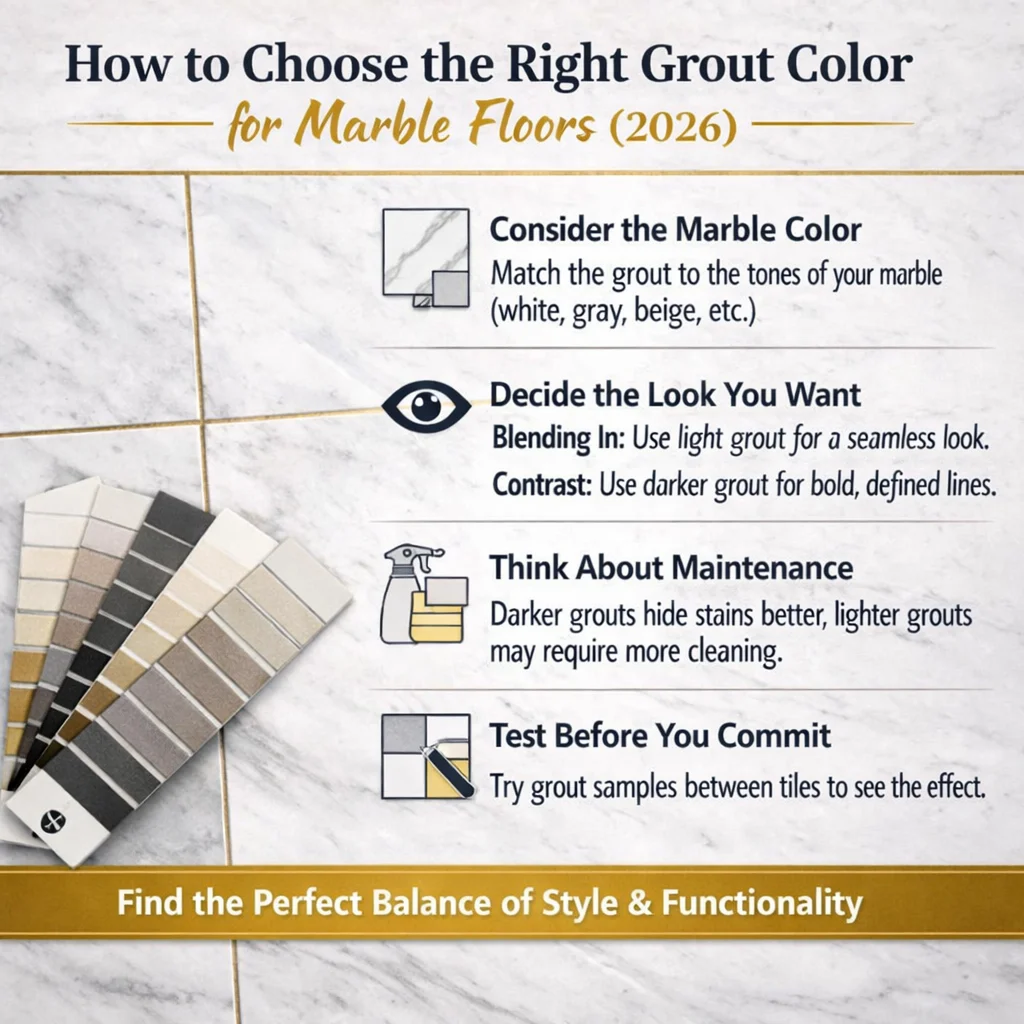
Light grout against light marble creates a seamless, expansive feel. Dark grout against light marble produces striking geometric patterns. And somewhere in between lies a whole spectrum of possibilities .
The Great Grout Color Debate: Match or Contrast?
This is the question that keeps homeowners awake at night. Do you want your grout to blend in or stand out? Both approaches have passionate advocates, and both can look stunning when executed thoughtfully.
The Seamless Approach: Matching Your Grout
When you match grout color closely to your marble’s dominant tone, something magical happens: the grout lines recede. The floor reads as a continuous surface, with the marble’s natural veining taking center stage .
This approach works beautifully for:
- Large-format tiles where you want an almost monolithic look
- Marble with complex, beautiful veining that shouldn’t compete with grid lines
- Small spaces where you want to minimize visual interruption
- Creating a calm, spa-like atmosphere
For white marbles like Carrara, Statuario, or Calacatta, a pure white or very light gray grout creates that seamless, elegant foundation . The key is finding a tone that truly disappears—not just close, but invisible.
The Bold Statement: Contrasting Grout
Then there’s the other path. Contrasting grout doesn’t hide—it announces. It frames each tile, emphasizes patterns, and adds graphic punch to your floor .
Choose contrast when:
- You have a simple tile pattern that would benefit from emphasis
- Your marble has relatively consistent coloration
- You want to highlight geometric layouts like herringbone or hexagon patterns
- Your design style leans toward dramatic or contemporary
White marble with charcoal grout creates that crisp, tailored look that’s so popular in modern design. Dark Emperador marble with matching dark grout maintains drama while minimizing visible lines .
Matching Grout to Your Specific Marble
Not all marble is created equal, and your grout color should respect your stone’s unique personality. Here’s a quick reference based on marble varieties:
The Practical Considerations Nobody Talks About
Here’s where we get real. Aesthetics matter enormously, but so does daily life. When you’re learning how to choose the right grout color, you must consider who lives in your home and what that floor will actually endure.
The Maintenance Reality Check
Light grout shows less dirt initially? Actually, that’s not quite right. Very light grout can show every bit of discoloration over time, while very dark grout might hide dirt but can fade or show wear differently . The practical sweet spot? Medium tones—soft grays, warm taupes, and balanced neutrals—tend to be the most forgiving in real-world conditions .
Think about your household honestly:
- Do you have kids who might track in who-knows-what?
- Is this a high-traffic entry or a low-use guest bathroom?
- How often do you realistically want to scrub grout lines?
- Are you okay with annual sealing maintenance?
For high-traffic areas or homes with realistic expectations about cleaning frequency, slightly darker or medium-tone grouts often prove more practical than pristine whites .
Joint Width Changes Everything
The size of your grout lines dramatically affects how color reads. Narrow joints (1/16 inch) practically disappear on their own, so matching grout to tile creates an almost seamless surface. Wider joints (1/8 inch or more) become actual design elements that can handle contrasting color beautifully .
For polished marble, unsanded grout is typically recommended for joints under 1/8 inch because it won’t scratch the delicate surface . Sanded grout contains particles that can abrade polished marble—a mistake you only make once .
The Science of Grout Types
Color isn’t the only decision. The type of grout you choose affects everything from application to long-term maintenance.
Cementitious Grout: The Traditional Choice
Standard cement-based grout comes in sanded and unsanded varieties. It’s affordable, widely available, and offers extensive color options. However, it’s porous—cement grout can absorb up to 7% water, compared to epoxy’s 0.5% . This means it requires sealing and regular maintenance .
For polished marble, unsanded cement grout protects the surface from scratches. For wider joints or textured marble, sanded versions provide additional strength .
Epoxy Grout: The High-Performance Option
Epoxy grout is essentially the superhero of the grout world. It’s non-porous, stain-resistant, and never needs sealing . For marble floors in kitchens, bathrooms, or anywhere spills happen, epoxy can be worth the higher cost and trickier installation.
Studies suggest epoxy grout lasts up to 30% longer than cementitious options . When you consider the cost and hassle of replacing grout down the road, that durability often justifies the initial investment .
Polymer-Modified Grout: The Middle Ground
These grouts incorporate additives that improve flexibility and reduce water absorption. They offer better performance than standard cement grout without the installation challenges of epoxy .
Testing: The Step Everyone Skips (And Shouldn’t)
Here’s the honest truth: grout color chips lie. Well, not intentionally, but they can’t tell you how that color will actually look against your specific marble in your specific lighting .
The right way to test involves:
- Taking actual tile samples to your space
- Applying grout samples between tiles and letting them fully cure (wet grout looks darker)
- Observing at different times of day—morning light, afternoon sun, evening artificial light
- Looking at both dry and damp conditions
- Considering adjacent materials—cabinetry, wall colors, countertops
This process takes patience, but it prevents the heartbreak of installation regret. One study suggests proper color testing can increase satisfaction by up to 30% .
Current Trends and Timeless Choices
Design trends for 2026 show interesting directions that might influence your decision. The Pantone Color of the Year is “Cloud Dancer”—a soft, billowy white that suggests movement toward lighter, airier spaces . This aligns with broader trends favoring clean neutrals with warm undertones over the cool grays of previous years .
Warm beiges, soft taupes, and creamy off-whites are gaining popularity as grout choices that feel both current and timeless . These tones complement marble’s natural warmth while avoiding the sterile feel that pure white can sometimes create .
But remember: trends come and go. Your marble floor will likely outlast any design fad. Choosing a grout color you genuinely love—not just what’s popular right now—is always the smarter move.
Practical Application Tips
Once you’ve made your color decision, proper installation protects your investment. A few key pointers:
Pre-seal very porous marble before grouting to prevent the grout from staining the stone edges .
Use a rubber float and work grout diagonally across tiles, pressing firmly into joints .
Clean haze promptly—on polished marble especially, dried grout residue can be miserable to remove .
Allow proper cure time before sealing or exposing to moisture—typically 24-72 hours for cementitious grouts .
Maintenance: Protecting Your Decision
Your beautiful new grout lines need ongoing care to stay beautiful. For cementitious grout, sealing every 1-3 years is essential . Use penetrating sealers formulated for natural stone rather than topical options that might alter appearance .
Clean with pH-neutral products only—acidic cleaners will etch marble and degrade grout over time . For routine maintenance, warm water and a soft cloth or sponge work perfectly .
When stains do appear (because life happens), address them promptly. A baking soda paste can work wonders on minor discoloration without damaging the stone .
Finding Confidence in Your Choice
After all this research, you might feel overwhelmed. Take a deep breath. The very fact that you’re thoughtfully considering how to choose the right grout color puts you ahead of most homeowners.
Start with your marble. What does it want? Look at its dominant tones, its subtle undertones, its personality. Then consider your space—the light, the size, the function. Finally, be honest about your maintenance preferences and lifestyle.
The right choice exists somewhere at the intersection of these considerations. And when you find it—when you see those grout lines disappear or beautifully frame your gorgeous marble—you’ll know.
At Sika Chemicals, we understand that every detail matters in creating spaces that last. Our comprehensive range of grouting solutions includes options specifically formulated for natural stone applications, providing the durability, color stability, and protection your marble deserves.
Whether you’re working with a contractor or taking on a DIY project, our team can help you select the right product for your specific needs. From high-performance epoxy grouts for moisture-prone areas to polymer-modified options for residential elegance, we’re committed to helping you build stronger, last longer.
Ready to bring your vision to life? Contact our support team or call us at 03329015232 for personalized guidance on your marble project. Visit our showroom to see grout samples alongside marble varieties and experience the difference quality makes. Your floors will thank you for years to come.