Table of Contents
Chemical Resistant Flooring for Factories in Faisalabad and Karachi: A Investment That Pays for Itself
The first time I walked into a textile factory in Faisalabad’s industrial area, the floor told me a story before anyone spoke a word. Dark stains where acid had eaten through the concrete. Cracked tiles near the dyeing machines. A patchwork of repairs that looked like a badly stitched quilt. The production manager sighed and said, “We redo sections every year. It’s exhausting.”
That conversation stuck with me. Because across Pakistan—from Karachi’s Korangi industrial zone to Faisalabad’s textile belt—thousands of factory owners are fighting the same battle. They’re spending money year after year on floor repairs, not realizing that the real solution isn’t more frequent fixes. It’s choosing the right material from the start.
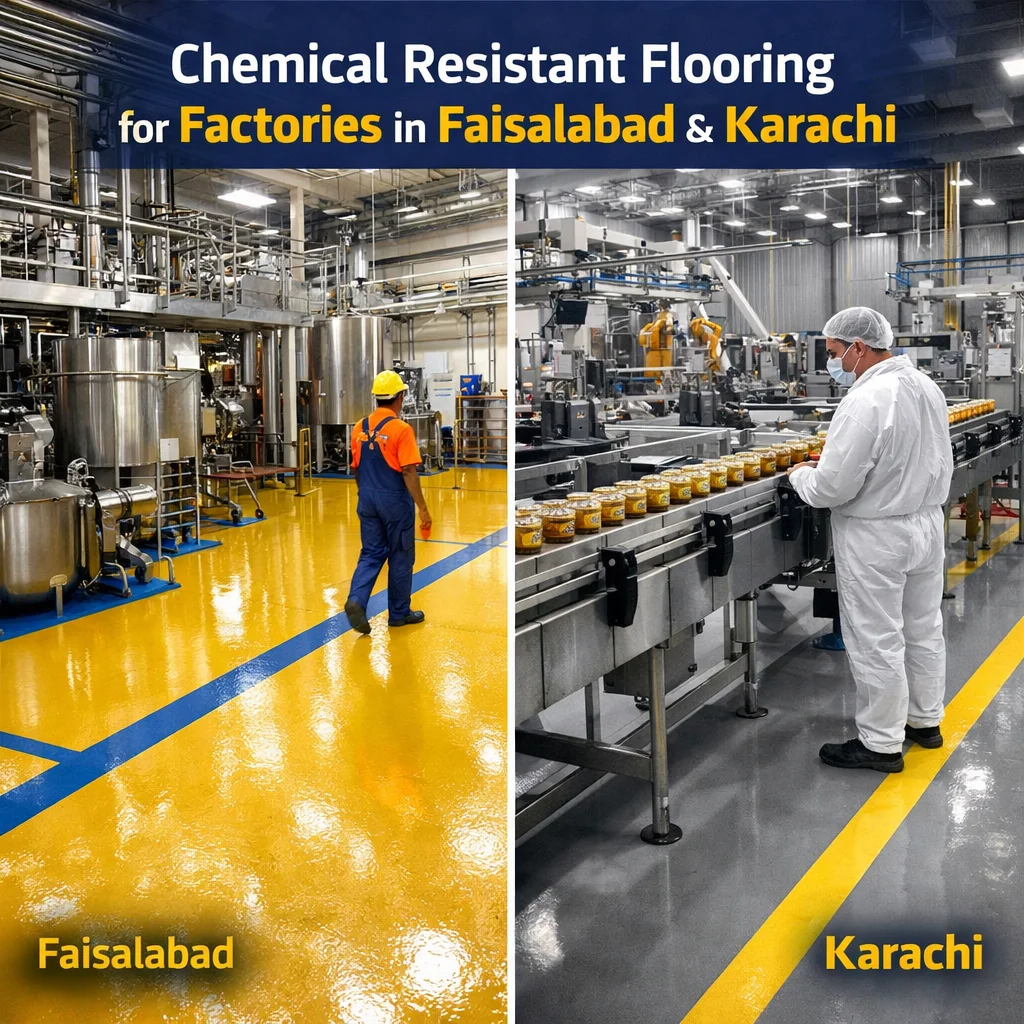
This is why chemical resistant flooring for factories in Faisalabad and Karachi has become more than just a technical specification. It’s become a business decision that separates smart operators from those who keep throwing good money after bad.
Why Regular Flooring Fails in Pakistani Industrial Conditions
Let’s be honest about what happens inside a working factory. Forklifts don’t glide gently—they thump and turn. Chemicals don’t arrive in neatly sealed containers—they splash during transfers. Workers don’t tiptoe—they walk, drag, and occasionally drop things.
Regular concrete or standard ceramic tiles simply aren’t built for this life . In Faisalabad’s textile units, the alkaline wastewater from dyeing processes seeps into porous concrete. Within months, the surface starts dusting. Within a year, you have visible deterioration. In Karachi’s chemical plants, acid spills that would make regular flooring bubble and dissolve are daily occurrences.
One pharmaceutical plant in Korangi shared their numbers with me. They were spending roughly Rs. 200,000 annually on floor repairs—patching cracks, replacing damaged tiles, dealing with drainage issues caused by deteriorating surfaces. When they finally invested in proper chemical resistant flooring, that expense dropped to nearly zero .
The Two Giants: Faisalabad vs Karachi
Faisalabad’s Textile Challenge
Faisalabad isn’t called Manchester of Pakistan for nothing. The city breathes textiles. And textile processing means water—lots of it—mixed with dyes, alkalis, and sometimes acids.
The challenge here isn’t just chemical resistance. It’s chemical resistance combined with constant moisture. Floors in Faisalabad’s dyeing and finishing units are never completely dry. They’re washed repeatedly. They’re exposed to high temperatures from drying processes. They need to handle both the chemistry and the hydraulics .
I visited a Faisalabad factory that had installed what they thought was industrial tile. Within eight months, the grout had dissolved, tiles were loose, and the underlying concrete was staining. The owner calculated that between production downtime and repairs, that failed floor had cost him three times what proper flooring would have.
Karachi’s Chemical Cocktail
Karachi presents a different beast. The city’s industrial zones host everything from battery manufacturing to food processing to petrochemical operations. The chemical exposure here is often more aggressive—concentrated acids, solvents, and oils .
Add to this Karachi’s humidity and coastal proximity. Moisture rising through concrete slabs can destroy improperly installed flooring systems. One battery plant in Site Area learned this the hard way when their “chemical resistant” tiles delaminated because the installer hadn’t accounted for moisture vapor transmission.
The lesson? Chemical resistant flooring for factories in Faisalabad and Karachi isn’t one-size-fits-all. Each city, each industry, sometimes each specific production line needs tailored solutions .
What Actually Works: Flooring Options That Deliver
Acid-Proof Tiles: The Traditional Workhorse
For many Pakistani factories, acid-proof tiles remain the go-to solution—and for good reason. These aren’t your home bathroom tiles. They’re dense, vitrified, and designed specifically for industrial abuse .
The best acid-proof tiles have:
- Water absorption below 0.5% (meaning chemicals can’t soak in)
- Compressive strength exceeding 400 kg/cm²
- Surface hardness that resists abrasion from forklift traffic
In Lahore’s pharmaceutical district, I’ve seen acid-proof tiles from brands like TAK Ceram perform flawlessly for over a decade in environments where regular tiles failed within months .
But here’s the catch—tiles are only as good as their installation. Regular cement grout will dissolve when it meets acid. You need epoxy-based adhesives and chemical-resistant joint fillers. Without these, even the best tiles will fail at the seams .
Epoxy Flooring: The Modern Contender
Epoxy systems have gained tremendous ground in Pakistani factories, and walking through a well-installed epoxy floor explains why. There are no joints. No grout lines. Nothing for chemicals to attack or bacteria to hide in .
Sikafloor® 261 is one example that’s gained traction in Pakistan’s industrial sector. It’s a two-component epoxy that delivers:
- Compressive strength around 56 MPa
- Chemical resistance across a wide pH range
- A seamless, impermeable surface
One Karachi food processing plant switched to Sikafloor after struggling with tile maintenance. Their quality control manager told me the seamless surface made sanitation infinitely easier—no more scrubbing grout lines, no more worrying about bacteria hiding in microscopic cracks .
Polyurethane Systems: When Flexibility Matters
Not all factory floors sit still. Some vibrate with machinery. Some experience temperature swings. Some need to flex without cracking.
Polyurethane flooring like Sikafloor® 2 SynTop offers advantages where epoxy might be too rigid. It absorbs impact better, handles thermal shock, and in some formulations, provides excellent slip resistance even when wet .
A Faisalabad textile unit with constant washing down cycles found polyurethane outperformed everything else they’d tried. The floor stayed intact despite daily temperature changes from hot water rinses to cool down periods .
The Hidden Factors That Determine Success
Surface Preparation: Where Most Projects Fail
Here’s something installers won’t always tell you: the coating or tiles themselves account for maybe 30% of the floor’s performance. The other 70%? Surface preparation .
Concrete must be properly cured, profiled, and cleaned. Moisture testing isn’t optional—it’s essential. One Lahore factory learned this when their beautiful new epoxy floor bubbled up within weeks. The concrete slab had moisture vapor emission rates that no coating could withstand.
For chemical resistant flooring for factories in Faisalabad and Karachi, the preparation phase should take at least as long as the application phase. Rushing this step guarantees failure .
Drainage and Slope: The Overlooked Essentials
Even the most chemical-resistant floor will deteriorate if chemicals pool and stagnate. Proper drainage isn’t just about water management—it’s about chemical management.
Factories that integrate flooring with smart drainage design extend floor life dramatically. The slope doesn’t need to be dramatic—1-2% is usually sufficient—but it needs to be consistent and planned before installation begins .
Joints: The Weak Link
In tiled systems, joints are where failure starts. Epoxy grouts and furan resins cost more than cement-based alternatives, but they’re non-negotiable for chemical exposure. One Faisalabad dyeing unit learned this when their cement grout dissolved within months, leaving tile edges exposed and vulnerable .
Cost Reality: Short-Term Pain, Long-Term Gain
Let’s talk numbers honestly. Quality chemical resistant flooring costs more upfront. There’s no escaping this.
- Basic concrete with hardener: Rs. 300-600 per sq. ft.
- Quality epoxy systems: Rs. 550-1,200 per sq. ft.
- Premium polyurethane: Rs. 800-1,500 per sq. ft.
The temptation to cut corners is real, especially when you’re budgeting for a new factory or expansion. But here’s what the math actually looks like:
A textile mill in Lahore installed 60,000 sq. ft. of epoxy flooring at Rs. 850 per sq. ft.—total investment around Rs. 51 million. Within two years, they’d reduced maintenance downtime by 30% and eliminated annual floor repairs that had been running Rs. 1.2 million per year .
The payback period? Less than three years. After that, every year is pure savings.
In Karachi, an automotive parts manufacturer switched to PU flooring. Two years later, maintenance costs had dropped 40%, and the floor showed virtually no wear despite constant forklift traffic .
Making the Right Choice for Your Factory
Questions to Ask Before You Decide
What chemicals are actually present? Not “we use chemicals generally.” Specifically—what acids, what concentrations, what temperatures? Different formulations handle different challenges.
What traffic will the floor see? Pedestrian-only zones need different specifications than forklift thoroughfares.
What’s the condition of your concrete slab? If the substrate is compromised, no surface treatment will save you.
Who’s installing it? Material quality matters, but applicator skill matters more. Ask for references. Visit past projects. Verify credentials .
Red Flags to Watch For
- Installers who quote without testing your concrete
- Prices that seem too good to be true (they usually are)
- Vague answers about chemical resistance certifications
- Reluctance to provide technical data sheets
The Human Element: Why This Matters Beyond Balance Sheets
During my visits to factories across Pakistan, I’ve noticed something. When floors are damaged—cracked, stained, patched—workers notice. They’re more careful where they walk. They’re less efficient moving materials. There’s an unspoken message that the workspace isn’t quite right.
But in facilities with well-maintained, quality flooring, something shifts. The space feels professional. Workers move confidently. There’s a pride in the environment .
One factory manager in Faisalabad put it simply: “When I gave my workers a good floor, they stopped complaining about the small stuff. They focused on their work. The floor told them I respected what they do here.”
That’s not something you can quantify on a cost-benefit analysis. But anyone who’s managed people knows its value.
Conclusion: The Floor as Foundation
Chemical resistant flooring for factories in Faisalabad and Karachi isn’t a luxury item or an optional upgrade. It’s foundational infrastructure—literally and figuratively.
The factories winning in Pakistan’s competitive industrial landscape understand this. They’re not looking for the cheapest option. They’re looking for the solution that delivers the lowest cost over the life of the facility. They’re investing in proper surface preparation, quality materials, and skilled installation because they’ve learned—often the hard way—that cheap flooring is the most expensive choice in the long run .
Whether you choose acid-proof tiles with epoxy grouting, a seamless Sikafloor system, or specialized polyurethane for temperature-sensitive areas, the principle remains: do it right once, or keep fixing it forever.
Ready to Invest in Flooring That Lasts?
At Sika Chemicals, we understand the unique challenges Pakistani factories face. Our range of industrial flooring solutions—from high-performance epoxy coatings to specialized chemical-resistant systems—is designed for the real conditions our customers operate in.
Don’t let another year pass with a floor that’s costing you money. Whether you’re planning a new facility or ready to upgrade an existing one, our technical team can help you select and specify the right solution for your specific needs.
[Contact Sika Chemicals Today] for a site assessment and consultation. Let’s build a floor that works as hard as you do.