Table of Contents
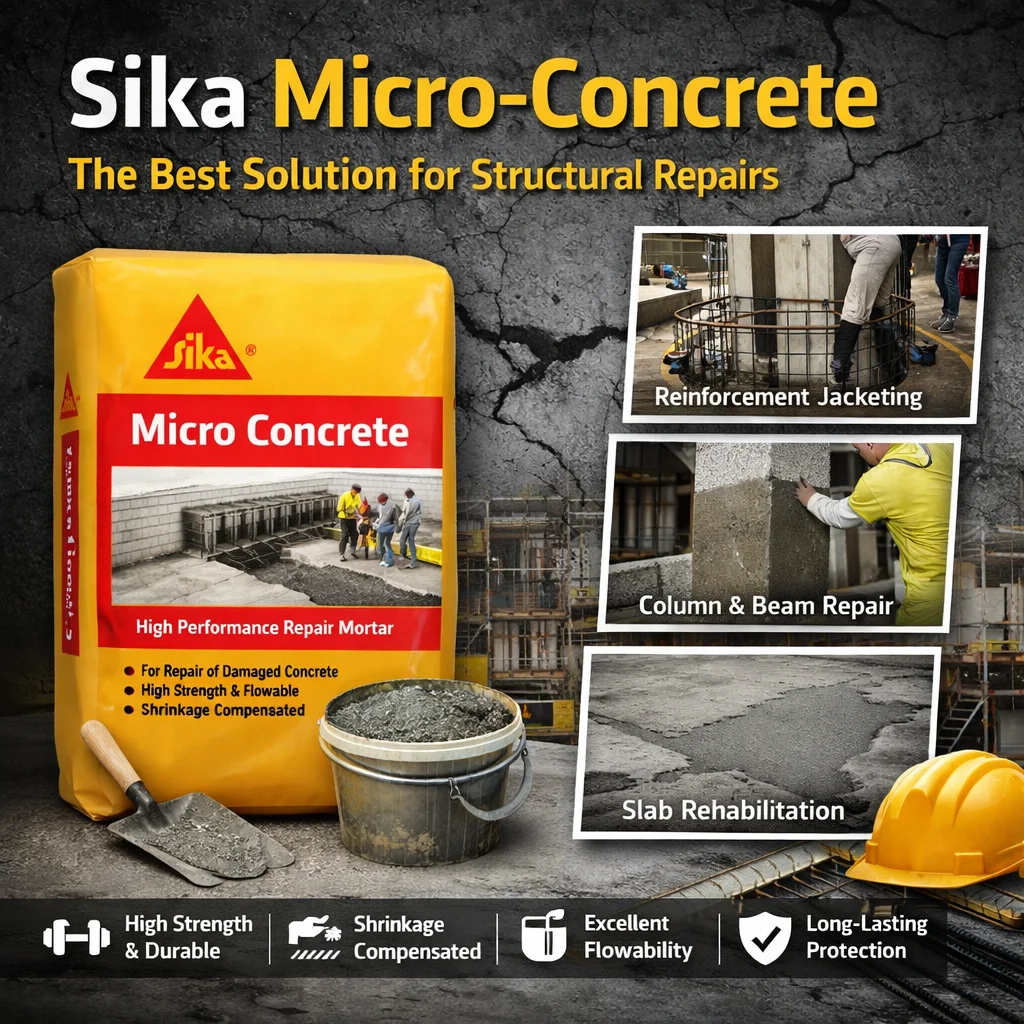
Sika Micro-Concrete: The Best Solution for Structural Repairs
When you first see a crumbling concrete beam or a spalled bridge pillar, it’s easy to assume the structure is beyond saving. I’ve stood on countless construction sites watching project managers run their hands over deteriorating concrete, that familiar crease of worry forming on their foreheads. The assumption has always been that significant damage means significant replacement. But here’s what I’ve learned over years in this industry: concrete tells a story, and with the right materials, most structures can be given a second chapter.
Enter Sika Micro-Concrete – a material that has fundamentally changed how we approach structural restoration. This isn’t just another repair product sitting on a warehouse shelf. It represents a philosophy shift from replacement to preservation, from temporary fixes to permanent solutions.
Understanding the Structural Repair Challenge
Before diving into solutions, we need to understand why traditional concrete repairs often fail. The construction industry has long struggled with a fundamental problem: conventional concrete is simply too bulky and rigid for precision repair work .
Think about what happens when a concrete column deteriorates. The damage isn’t uniform – it creates irregular cavities, exposes reinforcement in some areas while leaving others intact, and often occurs in spots that are physically difficult to access. Pouring standard concrete into these spaces is like trying to perform microsurgery with a butcher knife. The aggregate is too large, the flow is too limited, and the bond with existing material is often inadequate.
This is precisely where Sika Micro-Concrete enters the conversation as a game-changer.
What Makes Sika Micro-Concrete Different?
Sika Micro-Concrete isn’t simply “smaller concrete.” It’s an entirely different category of material engineered specifically for the unique demands of structural repair .
Precision Engineering at the Molecular Level
The magic happens in the formulation. Unlike traditional concrete with large aggregate that creates voids and weak points in repairs, Sika Micro-Concrete uses carefully graded fine aggregates, typically ranging from 3mm to 10mm depending on the specific product variant . This might sound like a minor technical detail, but its implications are enormous.
When I watched a repair crew working on a bridge column last year, the site engineer explained it this way: “Regular concrete is like trying to fill a crack with gravel. Micro-concrete is more like pouring honey – it finds every space, every corner, and bonds completely with the parent material.”
The free-flowing nature of Sika Micro-Concrete means it can navigate through congested reinforcement areas that would stop traditional concrete cold. It self-compacts, eliminating the need for vibration that might further damage weakened structures .
The Numbers That Matter
Let’s talk about what really matters in structural repair – performance data. Sika Micro-Concrete formulations consistently achieve impressive compressive strengths:
What these numbers translate to on an actual job site is confidence. When you specify Sika Micro-Concrete, you’re not guessing about performance. You’re working with materials that have been tested, certified, and proven across thousands of applications worldwide.
Real-World Applications: Where Theory Meets Practice
The Bridge That Refused to Die
I remember a particular project involving a 40-year-old bridge in northern Punjab. The inspection had revealed significant spalling on several support columns – classic reinforcement corrosion caused by years of exposure to road salts and monsoon moisture. The initial recommendation was complete replacement: three months of work and a budget that made the local authorities wince.
Instead, the engineering team opted for structural repair using Sika Micro-Concrete. The process was remarkably straightforward:
The deteriorated concrete was removed, exposing the corroded reinforcement. After proper cleaning and treatment of the steel, formwork was erected around the column. Then came the moment of truth – pumping Sika Micro-Concrete into the void.
Within seven days, the repair had achieved strength exceeding the original concrete. Within 28 days, those columns were stronger than they had been in decades. The bridge remains in service today, a testament to the fact that structural death sentences can be commuted with the right approach .
Beyond Bridges: Versatility in Action
The beauty of Sika Micro-Concrete lies in its adaptability. Different formulations address different challenges:
For deep structural repairs, products like Sikacrete®-114 can be poured in layers from 50mm up to 500mm thick, making it ideal for major reconstruction projects . The shrinkage-compensated formulation means you don’t get the cracking that plagues conventional concrete repairs.
For precision grouting where thickness exceeds 100mm, the same material provides exceptional flow characteristics while maintaining structural integrity .
For large volume repairs in vertical and overhead applications, spray-grade formulations like Sikacrete®-101 Standard CZ allow rapid application with minimal waste. The dust reduction technology is a particular favorite among site crews – it makes for a cleaner, healthier working environment .
For the cutting edge, specialized formulations like Sikacrete®-733 3D are being used in additive manufacturing applications, literally printing structural elements layer by layer .
The Human Element: Why Material Choice Matters
Construction is ultimately a human endeavor. Behind every repair specification are people whose lives depend on getting it right – the engineer calculating loads, the contractor mixing materials, and eventually, the families who will occupy or use these structures for decades to come.
I spoke with a site supervisor in Karachi who had worked with conventional repair materials for fifteen years before switching to Sika Micro-Concrete. His observation was simple but profound: “I used to worry about my repairs. I’d come back to sites months later and wonder if the bond had held, if cracks were forming, if I’d done enough. Now? I don’t worry. The material does what it promises.”
That peace of mind is impossible to quantify but impossible to overvalue.
The Economic Argument: Smart Money Moves
Let’s address the question that inevitably arises: “Is Sika Micro-Concrete worth the investment?”
The math works like this: A complete structural replacement costs everything – demolition, disposal, new materials, extended labor, and often, lost revenue from facility downtime. A properly executed repair using Sika Micro-Concrete typically costs 30-50% less than replacement while achieving comparable or superior structural performance .
But the real savings come from longevity. When repairs fail, you pay twice. The shrinkage compensation and superior bond strength of Sika Micro-Concrete mean repairs stay repaired. The low permeability and chloride resistance mean reinforcement stays protected . Structure owners aren’t just buying material; they’re buying decades of additional service life.
Application Excellence: Getting It Right
Even the best material requires proper technique. Based on extensive field experience and manufacturer recommendations, successful Sika Micro-Concrete application follows several critical principles:
Surface preparation is non-negotiable. All concrete surfaces must be clean, sound, and free from contaminants. Metal surfaces require similar attention – scale, rust, and grease must be removed completely .
Mixing discipline makes the difference between success and failure. Always empty full bags, never partial. Mix dry for three minutes before adding water, and use the precise water ratio specified – typically 4.0 to 4.25 liters per 40kg bag for standard formulations . Adding extra water for workability is tempting but fatal to performance.
Placement technique matters. Maintain sufficient hydrostatic head to keep material flowing. Provide channels for air to escape during grouting. For vertical applications, ensure formwork is secure and watertight .
Curing isn’t optional. Treat exposed surfaces with curing compound or use wet hessian and polyethylene sheeting. Proper curing isn’t an afterthought – it’s when the material develops its final properties .
Looking Forward: The Evolution Continues
The construction industry is changing rapidly, and Sika Micro-Concrete is evolving with it. Recent developments include formulations specifically engineered for 3D printing applications, opening possibilities for construction methods that were science fiction just a decade ago .
At the Citadel of Expertise project in France, Sika collaborated with Constructions-3D to develop SikaCrete® micro-concretes that enable robotic printing of entire building elements . This isn’t just innovation for innovation’s sake – it represents a fundamental shift toward more sustainable construction, reducing waste and material consumption while enabling complex geometries impossible with traditional methods .
Making the Choice: When to Specify Sika Micro-Concrete
Not every repair requires Sika Micro-Concrete. Minor surface imperfections might be adequately addressed with simpler materials. But when the conversation turns to structural integrity – to load-bearing capacity, to long-term durability, to safety margins – the calculus changes.
Consider Sika Micro-Concrete when:
- Repairs involve congested reinforcement where conventional concrete can’t flow properly
- Structural members require form-and-pour rehabilitation
- Thick-section pours exceed the capabilities of conventional repair mortars
- Early strength gain is critical for project schedules
- Long-term durability in harsh environments is non-negotiable
- Access limitations make vibration or compaction impossible
A Final Thought
I’ve spent enough time around construction to know that materials don’t lie. They either perform or they don’t. Specifications either prove themselves on site or they become expensive lessons.
Sika Micro-Concrete has earned its reputation the hard way – through decades of real-world performance in some of the most demanding applications imaginable. From bridges in Pakistan to tunnels in Europe, from parking structures in North America to marine facilities in Southeast Asia, this material has consistently delivered what it promises: structural repairs that actually last.
The next time you’re facing a concrete repair challenge that seems impossible, remember that impossibility is often just a failure of imagination – and materials. With Sika Micro-Concrete, the imagination has some excellent engineering to back it up.
Have you worked with Sika Micro-Concrete on your projects? We’d love to hear about your experiences. Share your stories in the comments below, or contact our technical team for personalized advice on your specific repair challenges.
Ready to start your next project with confidence? Browse our complete range of Sika Micro-Concrete products and schedule a consultation with our structural repair specialists