Table of Contents
Beyond the Mix: The Role of Sika Fiber in Preventing Concrete Shrinkage Cracks
There is a moment every contractor knows too well. You’ve just finished a perfect pour. The surface is smooth, the finish is clean, and you walk away satisfied. But the next morning, you return to find a network of fine lines spiderwebbing across the surface. The culprit? Shrinkage.
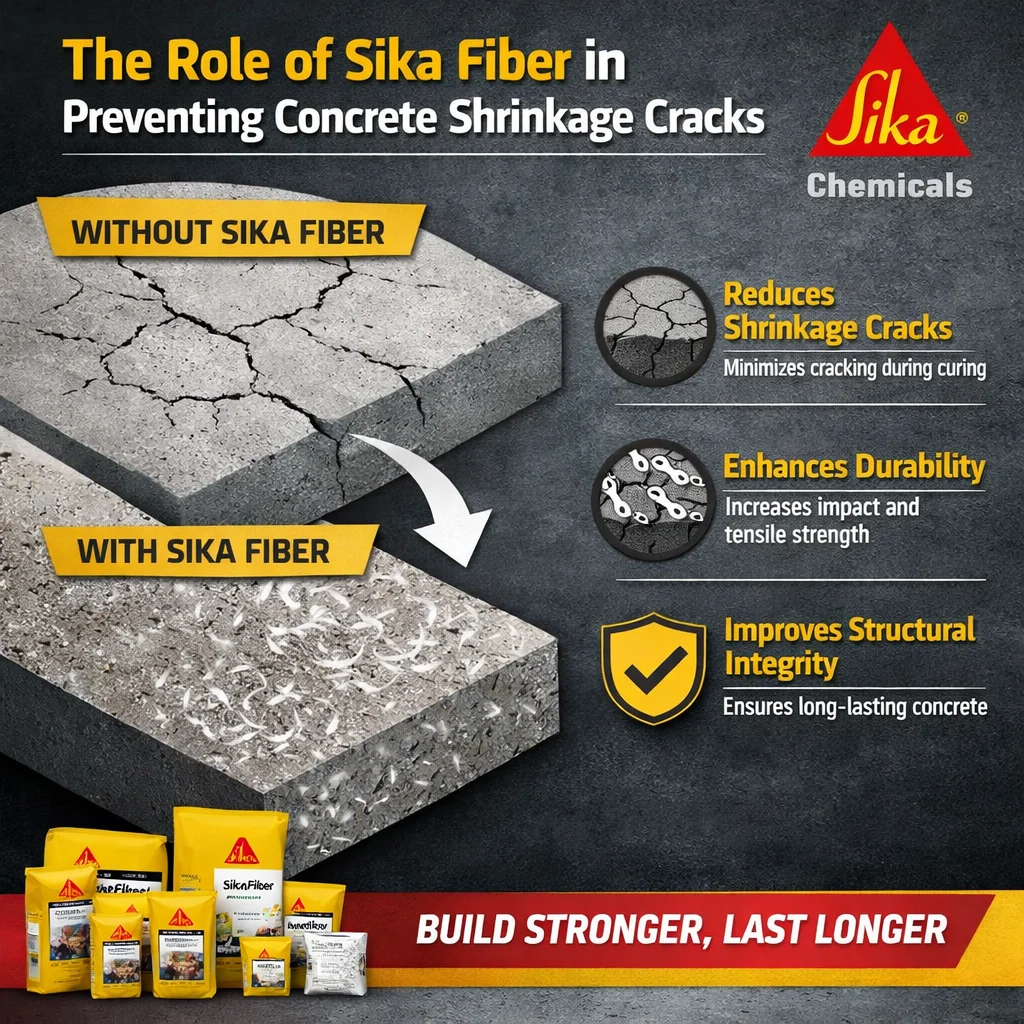
Concrete is a lot like life—it changes as it settles. As water evaporates from fresh concrete, the volume decreases. If the tensile stress from this shrinkage exceeds the concrete’s strength, it cracks. For years, the industry has fought this battle with water control, joint placement, and timing. But there is a silent guardian hiding within the mix itself that is changing the game: the role of Sika Fiber in preventing concrete shrinkage cracks is becoming the standard for modern construction .
Understanding the Enemy: Why Shrinkage Cracks Happen
Before we can appreciate the solution, we have to understand the adversary. Shrinkage cracks are not just cosmetic blemishes; they are gateways for water, chlorides, and other deleterious materials to enter the structure, leading to spalling, corrosion of reinforcement, and reduced lifespan.
There are two critical phases where shrinkage attacks:
- Plastic Shrinkage (The First Few Hours): When the concrete is still fresh (plastic), water evaporates from the surface faster than bleed water can replace it. This creates capillary tension that pulls the surface apart, resulting in those shallow, map-like cracks .
- Drying Shrinkage (The Long Game): As the concrete hardens and cures over months, excess moisture continues to leave. This causes the entire mass to contract. If this contraction is restrained by the subgrade or reinforcement, tension builds until the concrete tears .
Traditional methods like steel mesh attempt to hold the concrete together after it cracks. But wouldn’t it be better to stop the cracks from forming in the first place?
The Science of Prevention: How Sika Fiber Works
This is where the innovation of fiber technology comes into play. The role of Sika Fiber is not just to repair cracks, but to actively prevent their formation at the microscopic level.
Imagine millions of tiny, uniform “safety nets” distributed evenly throughout every cubic inch of the concrete. Unlike welded wire mesh, which sits in a single plane and can be accidentally pushed to the bottom of the slab during pouring, Sika fibers are three-dimensional. They go where the concrete goes .
Micro Fibers: The First Line of Defense
Sika offers micro synthetic fibers, like polypropylene monofilament fibers, which act immediately during that vulnerable plastic stage. These fibers are incredibly small but mighty. They work by:
- Reducing Bleeding: They support aggregate particles, reducing the amount of water that rises to the surface.
- Increasing Tensile Strain Capacity: While the concrete is still weak, the fibers provide a slight internal tensile resistance, absorbing the stresses caused by evaporation .
In fact, studies have shown that SikaFiber PPM micro fibers can reduce shrinkage crack formation by more than 90% by inhibiting the development of micro-cracks before they can enlarge into visible damage .
Macro Fibers: The Structural Partner
For applications requiring structural integrity post-cracking, Sika macro fibers (both synthetic and steel) take over. If micro cracks do attempt to form under higher stress, the macro fibers bridge the gap. They “sew” the two sides of the crack together, holding it tight and preventing it from widening. This process, known as crack control, ensures that if movement happens, it results in tight, harmless micro-cracks rather than gaping fissures .
A Personal Observation: The “No-Mesh” Difference
I recall visiting a site in Lahore where a large industrial floor was being poured. The project manager was stressed about the timeline because the steel mesh for the slab had been delayed. He was considering shutting down the crew. Instead, the supplier suggested switching to a SikaFiber reinforced mix.
Walking that floor after finishing was a revelation. Without the obstruction of wire mesh, the finishers moved faster, the surface was smoother, and the integrity was immediate. Months later, checking back on that floor, it remained tight and crack-free despite the heavy forklift traffic. That is the real-world impact. The role of Sika Fiber here was twofold: it saved the timeline and delivered a superior product.
Beyond Cracks: The Added Benefits of Fiber
While shrinkage control is the headline, the supporting cast of benefits is just as impressive. When you specify SikaFiber, you are not just preventing cracks; you are upgrading the concrete’s overall performance.
Choosing the Right Fiber for the Job
Not all fibers are created equal, and choosing the right one depends on the project’s goals. Sika’s portfolio is diverse, allowing engineers to pick the exact tool for the job .
- SikaFiber®-012 (Micro): Ideal for general purpose crack control in slabs, driveways, and pavements. It inhibits intrinsic cracking and improves impact resistance .
- SikaFiber® Force-50 (Macro): A structurally effective macro fiber used in precast elements and ground slabs. It can partially or totally replace traditional steel reinforcement in certain applications, increasing post-cracking strength .
- SikaFiber® Novocon® (Steel): For heavy-duty industrial slabs requiring high tensile strength and fatigue endurance. These hooked-end steel fibers provide excellent aggregate interlock at joints .
- Sika® Fibermesh® HP (Micro): A high-performance micro-fiber specifically engineered to reduce plastic shrinkage and settlement cracking while promoting uniform bleed .
The Sustainability Angle
In today’s construction environment, sustainability matters. Interestingly, the role of Sika Fiber extends into green building. By reducing the need for traditional steel reinforcement, we lower the carbon footprint associated with steel production. Furthermore, Sika fibers are often manufactured with lower embodied carbon and supplied in recyclable packaging .
Fiber-reinforced concrete also lasts longer. By mitigating cracks and preventing spalling, the structure requires less repair and maintenance over its lifecycle, conserving materials and reducing waste.
Conclusion: Building Stronger, Lasting Longer
Concrete is a forgiving material, but it has its limits. Water wants to leave, and when it does, stress builds. The genius of SikaFiber lies in its simplicity: distribute the stress evenly, and the concrete holds.
Whether you are pouring a residential driveway in Karachi or a massive industrial complex in Islamabad, the role of Sika Fiber in preventing concrete shrinkage cracks is undeniable. It transforms ordinary concrete into a high-performance composite, ensuring that the structure you build today remains the structure you rely on for decades.
At Sika Chemicals Pakistan, we believe in building stronger and lasting longer. Don’t let shrinkage cracks compromise your next project.
Ready to reinforce your next pour with the best in the business? Explore our full range of SikaFiber products or contact our support team to find the perfect solution for your specific needs. Build it right the first time. Build it with Sika.