Table of Contents
The Silent Profit Killer: Why Dust-Proofing Your Warehouse Floor with Sika Chapadur is a Business Essential
If you run a warehouse, factory, or workshop, you know the scene all too well. It starts as a faint grey haze in the morning light streaming through the loading bay. By afternoon, it settles like a fine, powdery blanket on every pallet, every machine, and every forklift. You sweep it, and within an hour, it’s back. That persistent, gritty layer isn’t just a housekeeping nuisance—it’s a sign that your concrete floor is slowly deteriorating beneath your feet.
Concrete is the backbone of industrial spaces, prized for its strength and durability. But even this robust material has a vulnerability: its surface. Under the constant assault of forklift traffic, heavy impacts, and general wear, the top layer of ordinary concrete begins to erode. This erosion releases fine particulate matter into the air. This is where the science of modern construction meets practical business sense, and why learning the process of dust-proofing your warehouse floor with Sika Chapadur is one of the smartest investments you can make for your facility.
In this article, we’ll move beyond the generic sales pitch. We’ll look at the real-world problems of industrial flooring, the limitations of standard concrete, and how a specific, time-tested solution provides a unique perspective on longevity, cleanliness, and operational efficiency.
The Dust Dilemma: More Than Just Dirt
To understand the value of a hardened floor, we have to look at what happens when you don’t treat it. I once visited a friend’s auto parts warehouse—a successful business with one nagging problem. Despite daily cleaning, a fine layer of dust coated everything. They had resorted to wrapping sensitive inventory in plastic, a costly and time-consuming workaround. “It’s just part of the business,” he shrugged.
But is it? Let’s break down the true cost of concrete dust:
- Equipment Damage: Dust acts as an abrasive. It works its way into forklift hydraulics, conveyor bearings, and the moving parts of heavy machinery, acting almost like a liquid sandpaper that accelerates wear and tear .
- Health and Safety: Prolonged exposure to concrete dust can be a respiratory hazard. Furthermore, a dusty floor can become slippery when mixed with oils or water, creating a safety risk for employees.
- Product Contamination: For warehouses storing goods, especially packaged food, pharmaceuticals, or electronics, dust contamination can lead to ruined stock and unhappy customers.
- Aesthetics and Morale: A constantly dirty facility looks unprofessional. It impacts the morale of employees who feel they are fighting a losing battle and creates a poor impression on clients visiting the site.
My friend’s warehouse wasn’t “just dusty.” It was suffering from a condition known as surface laitance and dusting—a direct result of the concrete’s surface not being dense enough to handle the mechanical wear of daily operations .
Why Ordinary Concrete Fails Under Pressure
To fix the problem, we must first understand the flaw in standard concrete. When you pour a standard slab, the heavier aggregates (stones and gravel) tend to settle, while the lighter particles—cement and water—rise to the top. This creates a thin layer on the surface that is rich in cement paste but lacks the structural integrity of the aggregate below.
This top layer, called laitance, is porous and relatively soft . When heavy forklifts turn on this surface, the abrasive force wears down this weak paste. The surface becomes pitted, and the fine cement particles become the dust you see. It’s a cycle: as the surface wears away, more aggregate is exposed, which can eventually become loose, creating an even rougher surface that generates more dust and debris.
The solution isn’t to pour thicker concrete; it’s to fundamentally change the nature of that top layer. You need to transform it from a weak cement paste into a dense, impact-resistant armor plate. This is the precise moment where the technique of dust-proofing your warehouse floor with Sika Chapadur shifts from a “nice-to-have” to a critical engineering decision.
Sika Chapadur: The “Armor Plate” Approach
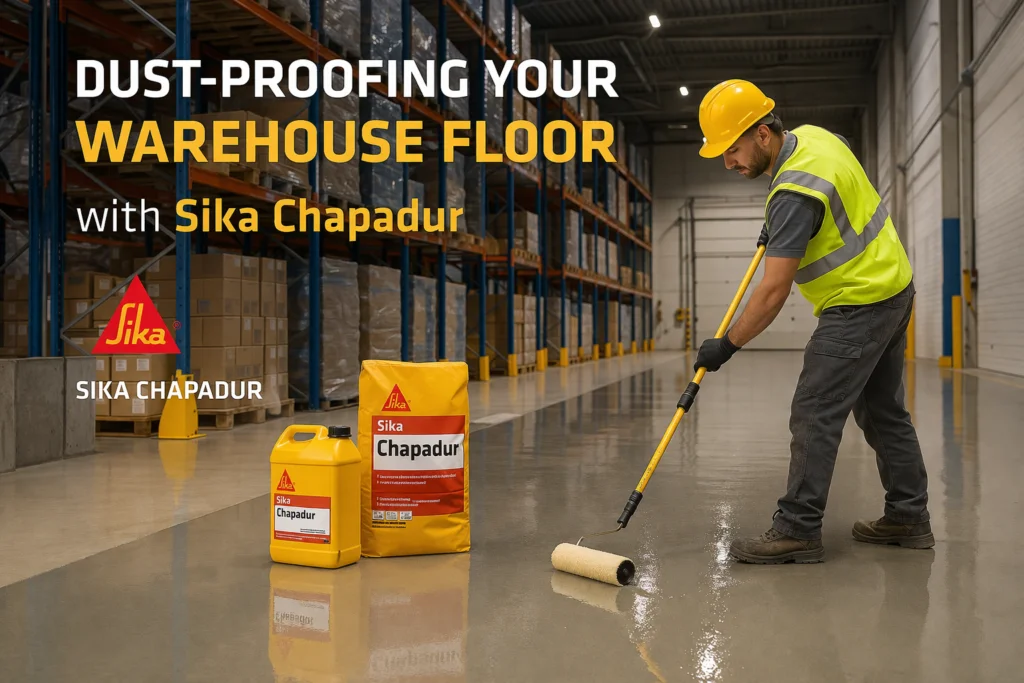
Sika Chapadur isn’t a paint or a sealer that sits on top of the concrete. It’s a “dry-shake” floor hardener. Think of it less like painting a wall and more like folding steel to make a sword. It becomes part of the concrete itself.
Composed of cement, specially graded hard aggregates of mineral origin (like quartz), additives, and pigments, Sika Chapadur is a pre-blended, ready-to-use powder . When applied correctly, it doesn’t just coat the floor; it chemically and physically bonds with the wet concrete to create a monolithic, super-dense surface.
The magic lies in those specially selected aggregates. With a Mohs hardness rating of 7 to 8—comparable to quartz—these granules are significantly harder than the surrounding cement paste . As the power trowel works the material into the surface, these hard particles pack tightly together, creating a surface that is incredibly resistant to abrasion.
The Art and Science of Application
There is a human element to applying Sika Chapadur that separates a good floor from a great one. It’s a dance between the concrete pour and the finishing team, requiring timing, skill, and experience.
1. The Window of Opportunity
The process begins the moment the concrete is screeded. The applicator must wait for the perfect moment—a “gut feel” honed by experience. They test the surface by pressing a thumb into the concrete. If it leaves a print about 3 to 5 mm deep, the time is right . Too early, and the Chapadur will sink into the slab and disappear. Too late, and it won’t properly bond, becoming a weak, separate layer.
2. The Two-Stage Broadcast
The Chapadur is typically broadcast in two stages. First, about two-thirds of the total amount (roughly 3-4 kg/m² depending on the duty requirement) is evenly scattered by hand or with a mechanical spreader . This initial layer is then worked into the surface using a power float or trowel, embedding those hard aggregates into the top of the concrete.
Immediately, the remaining material is broadcast and floated again. This two-stage process ensures full coverage and a consistently dense layer, usually achieving a thickness of 2.5 to 3.0 mm .
3. The Finishing Touches
As the concrete continues to set, the finishers return with their troweling machines. Starting with the blades flat at low speed, they compress the surface. As it hardens, they increase the blade angle and speed, performing a final polishing action that closes the surface pores completely. This final step is what gives the floor its smooth, dense, and reflective finish—a far cry from the dusty grey slab it once was.
Beyond Dust-Proofing: The Cascade of Benefits
While the primary goal of dust-proofing your warehouse floor with Sika Chapadur is to eliminate dust, the benefits cascade into every aspect of your operation.
- Superior Abrasion Resistance: Treated floors show 40-50% less wear than untreated concrete when subjected to rigorous abrasion tests . This means the floor stays smooth and level for years longer.
- Impact and Chemical Resistance: The dense surface is tougher and resists chipping from dropped loads. It also provides increased resistance to the penetration of oils, greases, and other chemicals that can stain and degrade ordinary concrete . Spills sit on the surface, where they can be easily cleaned, rather than soaking in like a stain.
- Ease of Cleaning: Because the surface is non-porous and smooth, it’s exponentially easier to clean. A simple sweep or rinse removes debris, rather than grinding it into the surface. This reduces labor costs and cleaning time.
- Reflective Properties: Many Chapadur applications result in a lighter, colored floor (natural grey is standard, but other colors are available). This increases light reflectivity, brightening the workspace and potentially reducing lighting costs .
A Personal Reflection on “Getting It Right”
I recall consulting on a project for a new food distribution center. The facilities manager, let’s call him Dave, was adamant about getting the flooring right. He had spent years managing a facility with a badly dusting floor and was determined not to repeat the mistake. He chose Sika Chapadur.
Pour day was a tense affair. The concrete pump hummed, the finishers moved with practiced precision, and Dave watched like a hawk. When the Chapadur was broadcast and floated, you could see the surface transform before your eyes. It wasn’t just changing color; it was gaining substance.
Three days later, as we walked on the cured floor, Dave did something interesting. He took a heavy metal wrench and scraped it hard across the surface. In an untreated warehouse, that action would have left a cloud of dust and a shallow groove. Here, it left a faint, silvery mark that you could almost buff out with your boot. He looked up and just smiled. That floor, years later, still looks almost new.
That experience cemented for me that choosing the right floor isn’t just about a product; it’s about choosing a performance specification for the life of your building. It’s about peace of mind.
Conclusion: Build Stronger, Last Longer
The dust in your warehouse is a symptom of a deeper issue—a floor that is slowly losing its integrity. Addressing it with temporary coatings or constant cleaning is like taking painkillers for a broken leg. It masks the symptom but doesn’t solve the underlying problem.
By investing in dust-proofing your warehouse floor with Sika Chapadur at the time of construction or renovation, you are making a strategic decision. You are opting for a floor that will support your operations efficiently, protect your equipment and products, and provide a safer, cleaner environment for your team for decades to come. It’s a foundational investment in the productivity and professionalism of your entire business.
At Sika Chemicals, we understand the demands of modern industry. Your floors need to be as tough as the work you do.
Ready to build a stronger, cleaner, and more durable foundation for your business? Don’t let a dusty floor hold you back.
👉 Contact our support team today to discuss your project and find the right Sika solution for you. Shop our full range of concrete admixtures and industrial flooring solutions at Sika Chemicals Pakistan.