Table of Contents
Building Through the Freeze: The Benefits of Sika Antifreeze for Winter Construction in Murree
The call came on a frigid January morning. A contractor from Murree was frantic—his crew had poured a foundation the previous afternoon, only to wake up to a landscape encased in ice. The concrete hadn’t set properly. Thousands of rupees in materials were compromised, and his project timeline was crumbling faster than the frost-damaged slab outside his site office. “I’ve been building here for fifteen years,” he told me, “and winter still finds ways to humble you.”
If you’ve ever built anything in Murree during winter, you understand this frustration. The pine-covered hills that draw tourists for snow holidays become a nightmare for construction professionals. When temperatures dip below 5°C, standard concrete behaves unpredictably. Water expands as it freezes, creating microscopic fractures that compromise structural integrity. Setting times double, then triple. Projects stall. Budgets bloat.
But here’s what seasoned builders in hill stations have learned: winter construction isn’t impossible—it just requires smarter chemistry. And that’s precisely where Sika Antifreeze transforms the game for Murree’s challenging climate .
The Murree Challenge: Why Winter Concrete Fails
Before diving into solutions, let’s understand what happens when you pour concrete in Murree’s December air. Murree sits at over 2,200 meters elevation, where winter temperatures routinely drop to freezing or below. The Pakistan Meteorological Department frequently records December and January temperatures between -2°C and 4°C in the region.
Concrete hydration is a chemical reaction—and like most chemical reactions, it slows dramatically in cold. When water in your concrete mix freezes, it expands by roughly 9%, creating internal pressure that cracks the uncured material. Even if the concrete survives initially, these micro-cracks become pathways for future water infiltration, leading to spalling, rebar corrosion, and premature failure.
A local contractor I spoke with near Kashmir Point shared his experience: “We lost an entire retaining wall project two years ago. Looked fine for a month, then spring thaw revealed cracks everywhere. Had to demolish and restart in April. Never again.”
Enter Sika Antifreeze: Chemistry That Works With Winter
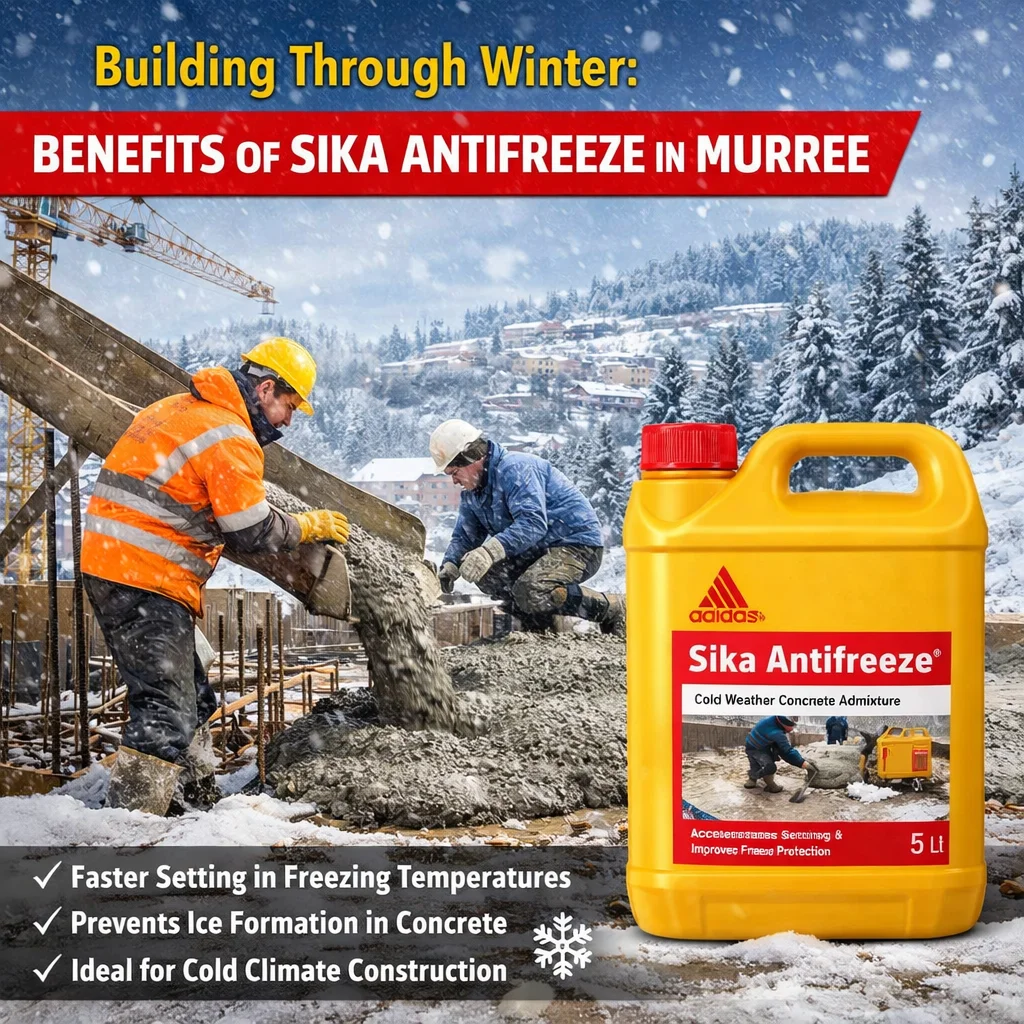
Sika Antifreeze isn’t magic—it’s sophisticated materials science developed specifically for conditions like Murree’s. Available through Sika Pakistan, this cold-weather admixture fundamentally changes how concrete behaves when temperatures drop .
The product works through multiple mechanisms simultaneously. First, it lowers the freezing point of water in the concrete mix, preventing the destructive ice crystal formation that typically wrecks winter pours. Second, it accelerates the hydration reaction between cement and water, helping concrete gain strength faster despite the cold .
What impresses me most is the technical precision. According to Sika’s product documentation, Sika Antifreeze contains no added chlorides, meaning it won’t promote corrosion in reinforced concrete—a critical consideration for Murree’s humidity and structural applications . It meets ASTM C 494 Type C standards, giving engineers confidence in its performance .
Personal Insight: I once watched a site supervisor in Abbottabad compare two test cubes after an overnight freeze. One with standard mix, one with Sika Antifreeze. The difference wasn’t subtle—the treated cube required a hammer to break; the untreated one crumbled under thumb pressure. That visual stays with you.
Practical Benefits for Murree Construction
Extended Working Season
Murree’s construction season traditionally runs March through October. That’s barely eight months. With Sika Antifreeze, progressive contractors are extending their working calendar significantly. The product enables concreting in “slight daytime frost” and “expected overnight frost” conditions—precisely what Murree experiences during shoulder seasons .
One developer building near Bhurban told me he now pours foundations into mid-December, giving him nearly two extra months annually. Over a multi-year project, that’s time savings that directly impact his bottom line.
Strength Development You Can Trust
The technical data is compelling. Sika Antifreeze helps concrete achieve the critical compressive strength of 4-5 N/mm² faster—this is the threshold where concrete can resist freezing damage . In practical terms, this means you’re not left guessing whether your pour survived the night. You know it’s developing strength even as temperatures drop.
Workability Without Compromise
Anyone who’s mixed concrete in cold weather knows the struggle—stiff mixes that don’t place well, leading to honeycombing and voids. Sika Antifreeze improves workability without requiring additional water, which would weaken the final product . The mix flows better into forms and around reinforcement, yet maintains its designed strength.
Corrosion Protection
This matters more than most realize. Some cheap alternatives protect against freezing but introduce chlorides that slowly destroy reinforcement from within. Sika Antifreeze is chloride-free, preserving the long-term integrity of your structure . For Murree’s buildings intended to last generations, this is non-negotiable.
Real Application: What Works in the Hills
Through conversations with contractors across northern Pakistan, I’ve compiled practical wisdom for using Sika Antifreeze effectively:
Timing matters. Add the admixture with the mixing water, not to dry ingredients . This ensures uniform distribution throughout the batch.
Temperature awareness. While Sika Antifreeze protects against freezing, it works best when concrete is placed above 5°C . Smart contractors in Murree schedule pours for late morning, after the site has warmed somewhat, rather than first thing at dawn.
Coverage compounds benefits. Using insulating blankets or plastic sheeting in combination with Sika Antifreeze creates ideal conditions. The admixture accelerates hydration while covers retain the heat generated by the chemical reaction .
Dosage precision matters. The recommended dosage is typically 1% of cement weight, though this can vary based on specific conditions . Working with Sika’s technical representatives to dial in your mix design pays dividends.
Beyond the Product: A Mindset Shift
What excites me about Sika Antifreeze isn’t just the chemistry—it’s what it represents for Pakistan’s construction industry. For too long, we’ve accepted seasonal limitations as inevitable. “Can’t pour in winter” was accepted wisdom.
But progressive builders are challenging that. They’re recognizing that modern construction chemicals eliminate many traditional constraints. Sika Antifreeze isn’t a workaround; it’s an upgrade to how we build in challenging environments.
A structural engineer I respect put it this way: “Every time I specify Sika Antifreeze for a Murree project, I’m buying insurance. Insurance against delayed timelines, against frost damage, against callbacks years later. That insurance costs a fraction of what one failure costs.”
Environmental and Economic Sense
Consider the economics of winter construction delays in Murree. Labor sits idle while crews wait for temperatures to rise. Equipment rentals continue. Site security costs don’t pause. Meanwhile, your capital is tied up in an incomplete project.
The cost of Sika Antifreeze is negligible compared to these carrying costs. We’re talking about adding a small percentage to your material budget to eliminate months of potential delays.
Environmentally, there’s another benefit: concrete that fails prematurely must eventually be demolished and replaced, doubling its carbon footprint. Building it right the first time with appropriate admixtures is genuinely more sustainable .
Practical Guidance for Your Next Project
If you’re planning winter construction in Murree, here’s my advice:
Start with certified material. Purchase Sika Antifreeze from authorized Sika Pakistan distributors to ensure authenticity. Counterfeit construction chemicals are sadly common and perform unpredictably .
Test your mix. Every cement source behaves slightly differently. Run trial batches with your specific materials before committing to full pours . Sika’s technical team can guide this process.
Train your crew. The best admixture fails if misapplied. Ensure your team understands when and how to add Sika Antifreeze, and why covering fresh concrete still matters even with chemical protection .
Document conditions. Keep simple records of air temperature, concrete temperature, and overnight lows. This data helps refine your approach over multiple projects.
The Bottom Line
Murree doesn’t stop being beautiful in winter, and your construction projects shouldn’t stop either. Sika Antifreeze represents a proven solution for the very real challenges of cold-weather concreting in Pakistan’s hill stations.
The contractors I respect most aren’t the ones who avoid difficult conditions—they’re the ones who’ve mastered working within them. They understand that quality construction isn’t about ideal circumstances; it’s about appropriate responses to real conditions.
Sika Antifreeze gives you that appropriate response. It’s not changing the weather; it’s changing how your concrete responds to it. And in a place like Murree, where winter is as reliable as sunrise, that makes all the difference.
Ready to build through the winter? Sika Chemicals Pakistan offers certified Sika Antifreeze along with technical support to help you optimize your mix designs for cold weather. Contact our team to discuss your specific Murree project, or visit our support center for guidance from professionals who understand Pakistan’s unique construction environments.
Have you tackled winter construction in hill stations? Share your experiences and questions in the comments below—I’d love to hear how you’re extending your building season.